When Should You Fold Subagents Into Your Main Agent Loop? Signs From Two Tests
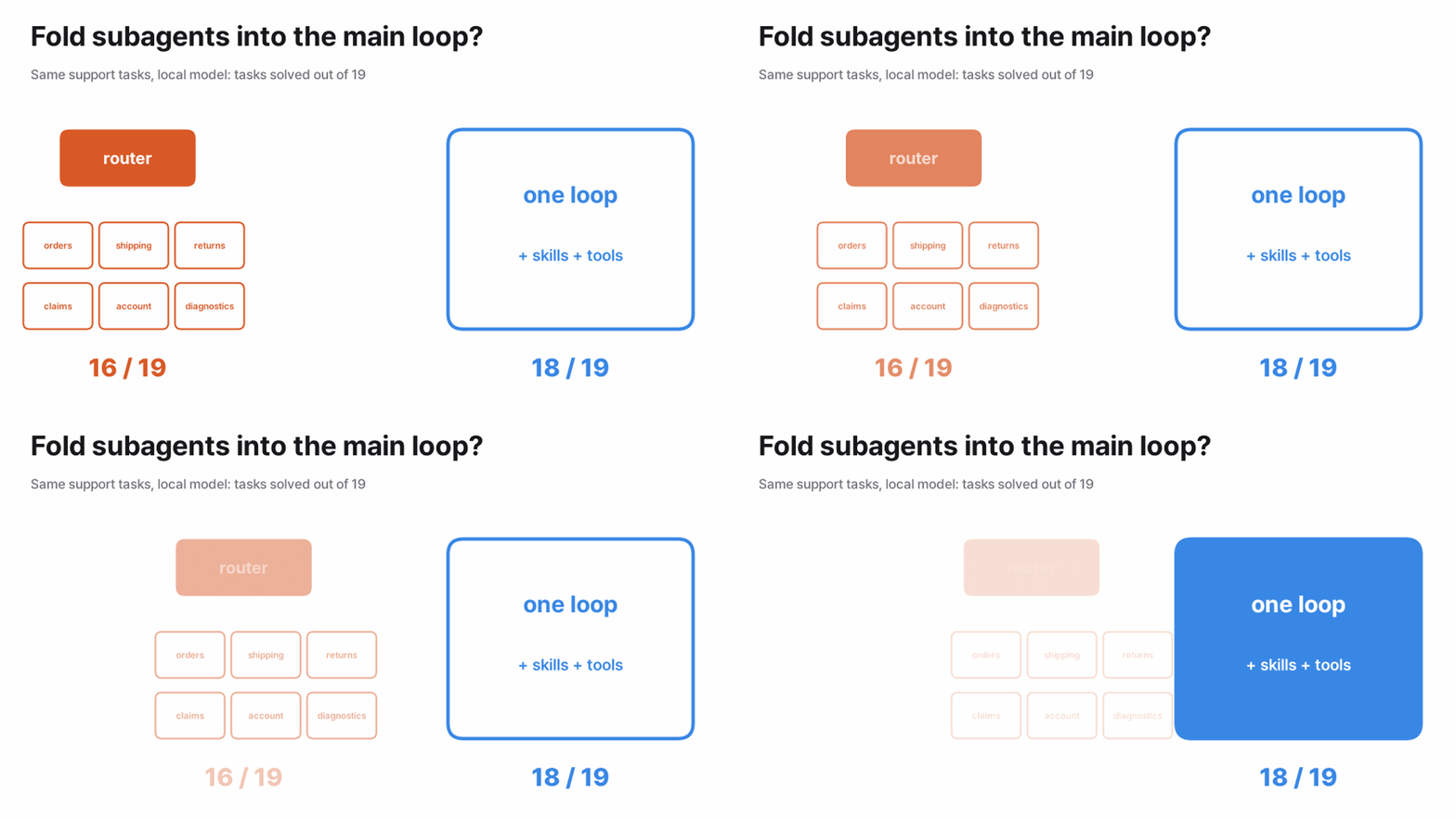
On a support kit run with a local model, a single loop solved 18 of 19 tasks and a router setup 16. In another test, on 12 runs of questions that needed three documents, skills got all 12 right and subagents 3. We traced the missed specialists, conflicting routing rules and extra call cost in the run logs.
A customer asked for an order's status and its delivery date together. The router called only the orders agent, and the final answer left out the delivery date. Run as a single agent that calls the tools itself, the same task got a complete answer. That date is what the split setup actually missed.
The same kind of problem came up again in two tests we ran on local models. Of the support kit's 19 tasks, the single loop solved 18 and the setup with a router and specialist agents solved 16. In another test, on 12 runs of questions that needed three documents together, the skills setup got all of them right and the setup where a supervisor asks subagents got 3. These results alone do not justify removing every subagent. We followed the run logs to see where folding helped and where a separate agent may still be needed.
What folding means
In a subagent setup, the main agent picks specialists, sends each a question, and collects their answers. Each specialist works only with the context it is handed. If a needed specialist is never called, or the step that combines answers goes wrong, the final answer can be wrong even when every specialist answered its own part correctly.
Folding moves a specialist's instructions into a skill the main agent loads when needed, and gives the main agent that specialist's tools directly. Decisions and conversation stay in one flow. Anthropic's Applied AI team named routers, planners and domain subagents as candidates for this in their post on folding subagents into the main agent loop (Diane Sarkis, October 22, 2026). It describes a customer whose run time became roughly twice as fast after moving to a single loop, but it gives no token or accuracy figures.
The setups we compared
The first test used the support kit Anthropic published. We ran its setup of one router and six specialists (orders, shipping, returns and others) and its folded single-loop version on Qwen3.8 Flash Next (IQ2_XS) served locally. There were 19 tasks, and each setup ran three times. Decoding was deterministic and the three runs matched, so the number of independent tasks is 19, not 57. Per-run results are in our support kit write-up.
The second test built a shop support agent five ways: all documents in one prompt, skills that load the documents needed, a supervisor with subagents, handoffs, and a router. We ran Qwen3.5-27B Q4_K_M in llama.cpp at temperature 0. Sixteen policy questions were asked three times each, so each setup was graded on 48 runs, and each also got a coding task with 60 hidden tests. Full conditions are in our five-setup comparison.
| Test 1: support kit | Test 2: five setups | |
|---|---|---|
| Model | Qwen3.8 Flash Next IQ2_XS | Qwen3.5-27B Q4_K_M |
| Split setup | router + specialists | supervisor + subagents, router |
| Folded setup | single loop calling tools directly | skills that load documents |
| Grading | the kit's per-task checks | a calculator, 60 hidden tests |
The models, tasks and grading differ, so the two tests' scores cannot be added into one win rate. Below we compare only the failure patterns they share.
The needed specialist was never called
The order and delivery question above is task t01 in the first test. The router asked only the orders specialist, so the answer had no delivery date. The Opus 5 run logs published with the kit show the same failure once per run, so it is hard to put this down to our local model alone.
In the second test, every setup got 12 of 12 on questions that needed one document. On questions that needed three, the setups split apart. The 12 in this table is four questions run three times each.
| Setup (Test 2) | 1-document questions | 3-document questions |
|---|---|---|
| skills | 12/12 | 12/12 |
| all documents in one prompt | 12/12 | 9/12 |
| supervisor + subagents | 12/12 | 3/12 |
| router | 12/12 | 4/12 |
| handoffs | 12/12 | 0/12 |
On one three-document question, the supervisor asked only the shipping and returns specialists. It never asked membership, so the information the answer needed was never gathered. In the skills setup, the agent that read the question picked the documents itself. On a two-document question, it loaded the shipping and membership documents together in its first call.
You can spot this failure by checking which specialist held the information missing from the final answer. If requests that need two specialists together come up often, those areas are candidates to fold.
The routing rules conflicted
Task t11 in the first test is a delayed order whose customer may want a return. The router prompt held three rules at once: look at orders before shipping, start with shipping for questions about timing, start with returns for returns. All of them applied to this request.
The router spent its whole 16,000-token output limit on thinking and gave no answer, which took 97 seconds. When we sent the same request again to read the log, it had gone back and forth between calling orders first and calling shipping and returns together until it hit the limit.
In the second test, the combining step stalled too. On a Gold member's electronics return, the returns specialist answered that the refund was $0.00 and the membership specialist answered that it could not compute the amount without the return rules. The router hit its token limit combining the two in all three runs. Across the router setup's 48 question runs, 11 answers were cut off, and those include runs cut off in the specialist step, not only the combining step.
Collect the requests in your run logs where the router's thinking runs long or the final answer is cut off, and you can see whether the same problem repeats on questions that span several areas. If it does, look at where the specialists' boundaries were drawn before adding more routing rules.
Sometimes only the call cost grew
While the main agent asks, the specialist answers and the main agent reads that answer back, model calls and tokens add up. Here is what we measured in the two tests.
| Split setup | Folded setup | |
|---|---|---|
| Test 1: model calls per task | 5.95 (router) | 3.16 (single loop) |
| Test 1: mean time per task | 19.7 s | 8.0 s |
| Test 1: output tokens per task | 1,820 | 529 |
| Test 2 questions: mean tokens | 6,422 (subagents) | 4,391 (skills) |
| Test 2 coding: mean tokens | 43,002 (subagents) | 21,601 (skills) |
The first test's 19.7 s includes t11's 97 s. Without that task, the router's mean is about 15.4 s, still longer than the single loop's 8.0 s. In the second test's coding task, both the subagent and skills setups passed all 60 hidden tests in all three runs. The subagent setup spent 1.99 times the skills setup's tokens for the same grade.
If the main agent mostly passes a specialist's answer through unchanged, check whether that call added any new judgment to the final answer.
Not only the structure changed
The first test's single-loop version changed its tools as well as the number of agents. It moved the return policy into a tool, tied every lookup to the signed-in customer, and removed example IDs from tool descriptions. So 18 against 16 cannot be credited to the loop structure alone.
On t16, the router version's diagnostics specialist used an example serial number from a tool description as a real value and read another customer's device log. The single-loop version had no example ID there and passed. In the other direction, the single loop failed t05. The return tool required a reason, so the model asked the customer for one and never checked whether the order was already past its return window. That is why tool inputs and descriptions need their own review when you fold.
When to keep a separate agent
Anthropic's guidance says a subagent can stay when the main loop's context grows enough that performance measurably drops, when work has to run at the same time in fresh contexts, or when one agent struggles with tool choice or conflicting instructions. Verification and separating permissions are also listed as uses.
Our two tests were far from those conditions. The second test's policy documents were 1,188, 898 and 756 tokens, so context size was not a constraint, and no task required parallel work. These results come from short, connected support work. If each specialist has to handle long documents, compare accuracy and cost before and after folding yourself.
A split setup still needs clear responsibility. In the second test, the handoff setup ran the coding task three times and passed none of the 60 hidden tests in any run, because no agent saved the file. If you keep several agents, decide who writes the final file and who gives the answer.
What to measure before you fold
Start with a small evaluation set. Anthropic says about 10 golden examples are enough to begin. Include requests that one specialist can finish and requests that need two or more, so missed calls show up.
Next, find in the run logs the specialists that get called together and the ones that tend to be missed. Folding one at a time and comparing per-task results is safer than folding everything at once. The total can stay the same while a task that used to pass starts failing. Check the example values and required inputs in the tool descriptions too.
If three runs of the same task give the same result under deterministic decoding, adding more kinds of tasks reveals more failures than adding repetitions. Our support kit write-up has the per-task run logs.
The newsletter below sends our next agent test when it is out.