Self-Evolving AI Agent Frameworks Compared (2026): GenericAgent, Evolver, Open Agents
Three self-evolving agent frameworks side by side. GenericAgent grows a skill tree from 3,300 lines of seed code behind a five-layer memory architecture, Evolver evolves agents through a Genomic Evolution Protocol, and Open Agents takes a third route. Includes how self-evolution differs from fine-tuning.
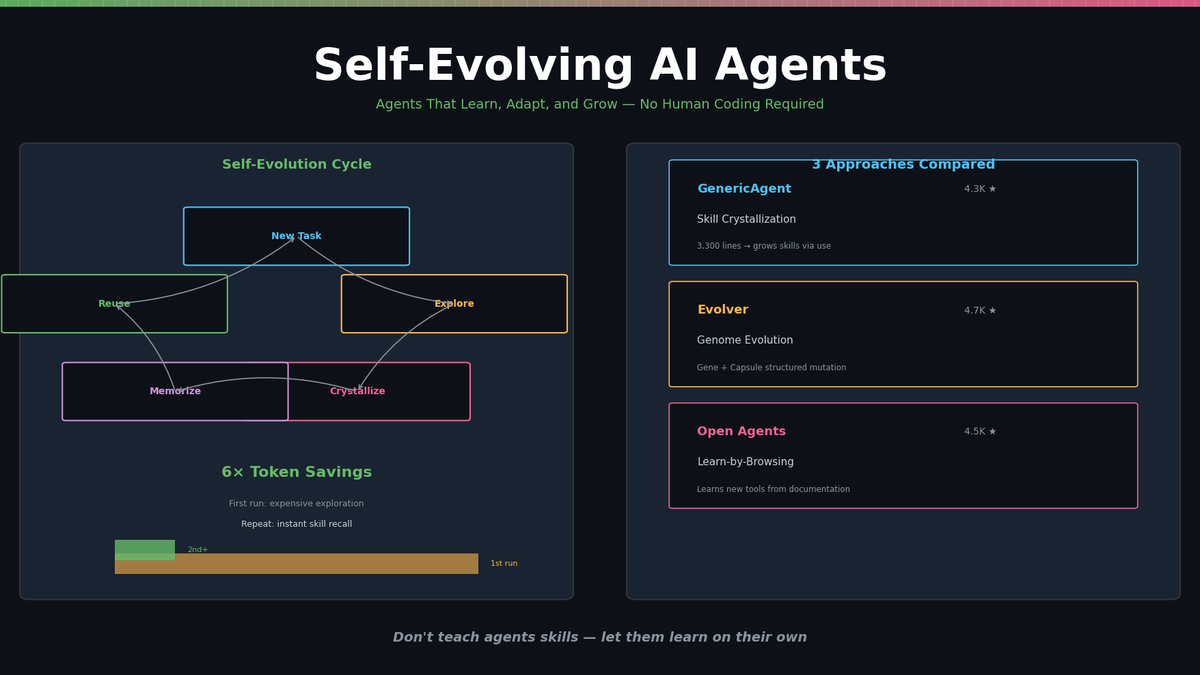
Self-Evolving AI Agent Frameworks Compared (2026): GenericAgent, Evolver, Open Agents
Don't teach agents skills. Let them learn on their own.
The Limits of Agent Frameworks
LangGraph, CrewAI, AgentScope — countless agent frameworks have emerged. But they all share a fundamental limitation: developers must predefine every capability.
You register tools, write prompts, and design workflows. What happens when an agent encounters a new situation? The developer has to modify the code again. The agent itself never truly "learns" anything.
In 2026, projects that challenge this fundamental constraint are rapidly gaining traction on GitHub. Self-evolving — a paradigm where agents create their own skills, remember execution paths, and learn from failures.
This article analyzes three projects with completely different approaches.
1. GenericAgent — A Skill Tree Growing from 3,300 Lines of Seed Code
GitHub: lsdefine/GenericAgent
Stars: 4,300+ (883 per day)
Core Idea
GenericAgent's philosophy is simple: Don't build a massive framework, plant a small seed and let it grow. The entire codebase is about 3,300 lines. For comparison, OpenClaw has 530,000 lines.
What's packed into these 3,300 lines:
- 9 atomic tools (code execution, file read/write, browser control, etc.)
- ~100 lines of agent loop
- 5-layer memory system
The rest? The agent builds it itself.
Skill Crystallization
GenericAgent's core mechanism is "skill crystallization":
New task → Autonomous exploration → Execution path crystallization → Memory storage → Direct reuse next timeExample:
- "Order food from a delivery app" (first time)
→ Explores app, learns UI, completes order (high token cost)
- "Order again" (second time)
→ Calls crystallized skill, executes immediately (low token cost)
This is the secret behind the 6x token savings. It's expensive at first, but gets cheaper with repetition.
5-Layer Memory Architecture
| Layer | Name | Role |
|---|---|---|
| L0 | Meta Rules | Core behavioral constraints |
| L1 | Insight Index | Routing and recall indexing |
| L2 | Global Facts | Accumulated stable knowledge |
| L3 | Task Skills/SOPs | Reusable workflows |
| L4 | Session Archive | Session logs for long-term recall |
L1 serves as the routing layer, fetching "exactly the knowledge needed." This is why it works within a 30K context window (while competitors require 200K-1M tokens).
Self-Proof
The most impressive fact: The repo itself was built by GenericAgent. Of 388 commits, none were manually typed in a terminal by a human. The agent wrote its own code, debugged it, and committed it. This is the strongest evidence of self-evolution.
Key Differentiators
- Real browser integration: Injected into actual browsers, not sandboxes, maintaining login sessions
- Mobile support: Android device control via ADB
- Multi-model: Supports Claude, Gemini, Kimi, MiniMax, and more
2. Evolver — Genomic Evolution Protocol
GitHub: EvoMap/evolver
Stars: 4,700+ (866 per day)
Core Idea
If GenericAgent "crystallizes skills," Evolver "protocolizes evolution." Instead of arbitrarily modifying prompts, it performs structured evolution through assets called genes and capsules.
Genomic Evolution Protocol (GEP)
Evolver's core is three asset types:
assets/gep/
├── genes.json      # Atomic evolution patterns (reusable improvement units)
├── capsules.json   # Composite evolution strategies (gene combinations)
└── events.jsonl    # Auditable evolution history (append-only log)
Evolution Workflow
Signal detection → Gene/capsule selection → Mutation generation → Prompt emission → Event logging- Signal extraction: Analyze error patterns from runtime logs in
memory/directory - Gene selection: Score relevant evolution assets using signal matching algorithm
- Mutation generation: Create mutation objects with explicit parameters controlling each evolution run
- Prompt emission: Generate protocol-based prompts (not arbitrary code execution)
- Event logging: Record all evolution events to
events.jsonlfor traceability
Self-Evolution vs. Fine-tuning
| Aspect | Self-Evolution (Evolver) | Fine-tuning |
|---|---|---|
| Mechanism | Protocol-based discrete evolution cycles | Continuous gradient-based model updates |
| Auditability | Explicit EvolutionEvent records | Black-box weight changes |
| Determinism | Deterministic, reviewable change tracking | Stochastic, cumulative adjustments |
| Rollback | Git-based rollback + blast radius calculation | Checkpoint-based, requires retraining |
| GPU | Not required | Required |
Key difference: Evolver evolves how the agent behaves. Fine-tuning changes what the model knows. These are optimizations at completely different layers.
Strategy Presets
# Balanced (default): 50% innovation, 30% optimization, 20% repair
EVOLVE_STRATEGY=balanced node index.js --loop

# Harden: 20% innovation, 40% optimization, 40% repair
EVOLVE_STRATEGY=harden node index.js --loop

# Repair-only: 0% innovation, 20% optimization, 80% repair
EVOLVE_STRATEGY=repair-only node index.js --loop
For production environments, harden or repair-only is recommended for stability, while balanced is suggested for experimental environments to pursue innovation.
Safety Mechanisms
Evolver has several built-in safety mechanisms:
- Signal deduplication: Prevents recursive repair loops
- Stagnation detection: Blocks infinite evolution cycles
- Source file protection: Prevents agents from overwriting core code
- Validation gates: Validity checks before applying evolution
3. Open Agents — Vercel's Cloud Agent Reference
GitHub: vercel-labs/open-agents
Stars: 3,100+ (735 per day)
Core Idea
While GenericAgent and Evolver focus on "agent evolution," Vercel's Open Agents focuses on "agent infrastructure." This is Vercel's answer to "How do you run autonomous coding agents in production?"
3-Layer Architecture
Web Layer (Next.js) → Agent Workflow (Durable) → Sandbox VM (isolation)Critical design decision: The agent runs outside the sandbox.
While most frameworks put agents inside sandboxes, Open Agents separates the agent from the execution environment. This enables:
- Independent sandbox hibernation/resumption
- Agent execution that transcends individual request lifetimes
- Independent swapping of models and sandbox implementations
Durable Execution
Built on Vercel's Workflow SDK, agent tasks survive server restarts:
- Persistent execution of multi-step workflows
- Streaming and cancellation support
- State management across long-running tasks
This is infrastructure-level durability that GenericAgent and Evolver don't have.
Agent Capabilities
- File read/write/edit/search
- Semantic code search
- Shell command execution
- Repo cloning, branch management, automatic commit/PR creation
- Session sharing (read-only links)
- Skill system (
.agents/skills)
Why Include It in This Article
Open Agents isn't a "self-evolving" agent. But it shows the infrastructure needed for evolution engines like GenericAgent or Evolver to run in production:
- Evolving agents must survive server restarts → Durable Execution
- Autonomous agents must safely execute code → Sandbox isolation
- Evolution results must be reflected in actual code → Git integration + PR automation
GenericAgent's skill tree + Evolver's genomic protocol + Open Agents' infrastructure = Production-ready self-evolving agent system.
Comparing the Three Projects
| Dimension | GenericAgent | Evolver | Open Agents |
|---|---|---|---|
| Core Innovation | Skill crystallization | Genomic evolution protocol | Agent-sandbox separation |
| Code Size | 3,300 lines | ~5K lines | Large reference app |
| Evolution Method | Execution → Crystallization | Signal → Mutation → Prompt | None (provides infrastructure) |
| Learning Location | L3 Task Skills | genes.json + capsules.json | N/A |
| Auditability | Session archives | Full EvolutionEvent tracking | Git history |
| Production | Local-focused | Local + daemon mode | Vercel cloud |
| Safety | Basic | Stagnation detection, source protection, validation gates | Sandbox isolation |
| Language | Python | JavaScript (Node.js) | TypeScript (Next.js) |
The Paradigm Spectrum
Predefined (LangGraph, CrewAI)
  └── Developer designs everything
        ↓
Skill Crystallization (GenericAgent)
  └── Agent extracts skills from experience
        ↓
Protocol Evolution (Evolver)
  └── Structured gene-based evolution
        ↓
Infrastructure (Open Agents)
  └── Foundation for all of the above to work in production
What Self-Evolution Means
Changed Token Economics
Traditional agents: Pay the same cost every time. Do the same task 100 times, consume 100x the tokens.
Self-evolving agents: Expensive at first, exponentially cheaper afterward. GenericAgent's 6x savings claim comes from this structure. ROI increases as skills accumulate.
The End of Prompt Engineering?
Evolver's genomic protocol elevates prompt engineering to an engineering discipline. No longer dependent on individual intuition. Evolution assets are version-controlled, auditable, and shareable.
New Questions
But new questions arise:
- Where are the safety boundaries? If agents self-evolve, how far should we allow it? Evolver answers with validation gates and source protection, but is this enough?
- Who guarantees skill quality? What if a skill crystallized by GenericAgent is wrong? Automatically learned bad habits spread automatically.
- Dependency issues: Will skills learned in one environment work in another?
Closing: From Tool to Colleague
2024: AI emerged as a tool. It only does what you tell it.
2025: AI evolved into an agent. It works autonomously.
2026: AI is transforming into a learner. It learns from experience, remembers failures, and grows on its own.
GenericAgent's skill crystallization, Evolver's genomic evolution protocol, and Open Agents' production infrastructure — these three projects point in the same direction: AI that remembers forever after being told once and gets better with every failure.
The most intriguing part is that this isn't about bigger models or more data, but architectural innovation. It's possible with just 3,300 lines of code. It's possible with a genomic evolution protocol. What matters isn't the size of the model, but the structure of memory and learning.
Projects featured in this article:
- GenericAgent — Self-evolving skill tree agent (4.3K stars)
- Evolver — Genomic evolution protocol engine (4.7K stars)
- Open Agents — Vercel's cloud agent reference (3.1K stars)