90% of Your Agents Should Just Be Python Scripts: Anatomy of Quadratic Token Costs
We ran the same 10-file daily transaction triage (180 records, 3 anomalies) on Claude Haiku 4.5 two ways. A runtime agent loop burned 102,546 input tokens and 20.7s across 12 turns and failed on turn 12. Asking the same model once (379 input tokens) to write a Python script passed 30/30 runs in 38.8ms each — 7,569x cheaper hourly even with 100% prompt caching.

Teams routinely wire a runtime AI agent to a recurring ops job, then get blindsided by the API bill a month later. Even a simple job — scan 10 files, flag bad rows, sum the rest — does not scale linearly inside an agent loop. Because every turn re-sends the growing conversation history, total input tokens explode quadratically ($O(N^2)$) with the number of turns.
We measured how fast that curve actually explodes — and tested the standard counter-argument ("doesn't prompt caching fix this?") — using the exact same model (claude-haiku-4-5-20251001, temperature 0) on the exact same daily transaction triage job:
- Dataset: 10 deterministic JSON batch files (
batch_01.jsonthroughbatch_10.json, seed20261121, 180 records total) with 3 injected anomalies (duplicatetx_idTX-0042, negativeamountTX-0100, emptycustomer_idTX-0155), targeting the exact anomaly IDs and the 2-decimal sum of the 177 valid rows (21,848.68). - Approach A (Runtime Agent Loop): Give the agent 3 tools (
list_files,read_file,write_report) and let it inspect the 10 files turn by turn. - Approach B (Code-Gen Once + Plain Python): Show the same model 2 sample rows and 3 rules once, generate a standalone Python script, and execute it 30 times (30 days).
The gap was stark. The runtime agent burned 102,546 input tokens and 20.71 seconds on a single run, then hit max_tokens mid-arithmetic on turn 12 and never called write_report. Meanwhile, the Python script generated once by the exact same model for 379 input tokens (5.15s) passed 30/30 runs in 38.8 ms each with zero rounding drift. Even assuming 100% prompt cache hits on every turn, an hourly runtime loop still costs 7,569× more over 30 days.
Below we walk through the exact 12-turn quadratic ramp and its closed-form scaling, the real prompt-caching math, two common objections (max_tokens and run_python), and a 3-tier decision table with a hybrid fallback pattern.
The 12-turn quadratic ramp, turn by turn
LLM APIs are stateless. Reading batch_01.json on turn 2 means re-paying for batch_01.json on turns 3, 4, 5, all the way through turn 12. All 10 raw files combined are only ~16.5K tokens, yet the 12-turn loop billed 102,546 input tokens — more than 6× the size of the data itself.
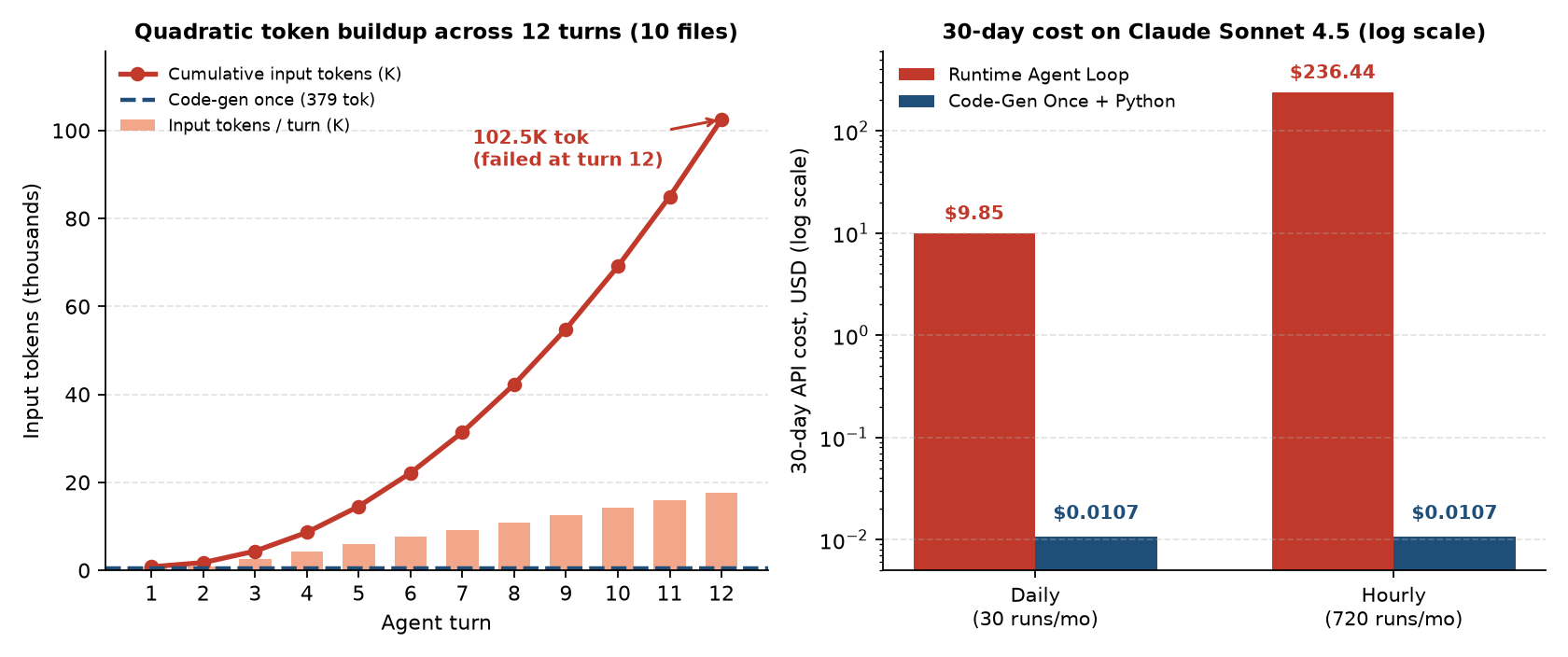
| Turn | Tool called | Input tokens | Delta | Cumulative input | Latency |
|---|---|---|---|---|---|
| 1 | list_files | 804 | — | 804 | 1.22 s |
| 2 | read_file (batch_01) | 948 | +144 | 1,752 | 1.25 s |
| 3 | read_file (batch_02) | 2,610 | +1,662 | 4,362 | 1.30 s |
| 4 | read_file (batch_03) | 4,265 | +1,655 | 8,627 | 1.26 s |
| 5 | read_file (batch_04) | 5,919 | +1,654 | 14,546 | 1.68 s |
| 6 | read_file (batch_05) | 7,597 | +1,678 | 22,143 | 1.31 s |
| 7 | read_file (batch_06) | 9,251 | +1,654 | 31,394 | 1.27 s |
| 8 | read_file (batch_07) | 10,905 | +1,654 | 42,299 | 1.58 s |
| 9 | read_file (batch_08) | 12,580 | +1,675 | 54,879 | 1.28 s |
| 10 | read_file (batch_09) | 14,234 | +1,654 | 69,113 | 1.25 s |
| 11 | read_file (batch_10) | 15,882 | +1,648 | 84,995 | 1.68 s |
| 12 | *(truncated summing, no tool call)* | 17,551 | +1,669 | 102,546 | 5.62 s |
Every file adds roughly 1,655 tokens ($\Delta$) to every subsequent turn. With fixed prompt/tool prefix $S$ and $N$ turns, total input follows the arithmetic series:
$$\text{Total Input} \approx N \cdot S + \Delta \cdot \frac{N(N-1)}{2}$$
Doubling the files quadruples the tokens; 5× the files multiplies input tokens by 22×:
| Files | Turns ($N$) | Final turn input | Total input / run | Sonnet 4.5 cost / run (no cache) |
|---|---|---|---|---|
| 10 (measured) | 12 | 17,551 | 102,546 | $0.33 |
| 20 (projected) | 22 | ~35,559 | ~399,993 | $1.20 |
| 50 (projected) | 52 | ~85,209 | ~2,236,338 | $6.71 |
In a 3-file demo, the bill is pennies and nobody notices. In production at 50 files, a single run burns 2.24 million input tokens.
Worse than the bill: failing on turn 12
After burning 102,546 input tokens and 20.71 seconds, the runtime agent still failed. On turn 12, trying to sum 177 floating-point amounts in text exhausted max_tokens=512 before it could call write_report.
Code-gen once + 30 Python runs on the exact same model
| Metric | Approach A: Runtime Agent (1 run) | Approach B: Code-Gen Once + Python (30 runs) | Difference |
|---|---|---|---|
| Input tokens | 102,546 (per run) | 379 (once ever) | 270× on run 1 |
| Output tokens | 1,383 (per run) | 635 (once ever) | — |
| Execution time | 20.71 s / run | 38.8 ms / run (5.15 s gen) | 534× faster |
| Accuracy | Failed (0 / 1) | 30 / 30 (100% exact) | Deterministic |
"Doesn't prompt caching solve this?" — exact math
Applying Claude Sonnet 4.5's official caching rates ($3.75/M cache write, $0.30/M cache read, $15.00/M output) to our exact 12-turn trace (17,551 cache-write tokens, 84,995 cache-read tokens, 1,383 output tokens):
| 30-day cadence (Sonnet 4.5) | Runtime Agent (no cache) | Runtime Agent (100% cache hit) | Code-Gen Once + Cron | Gap vs cached |
|---|---|---|---|---|
| 1 run | $0.3284 | $0.1121 (-65.9%) | $0.0107 | 10.5× |
| Daily (30 runs) | $9.85 | $3.36 | $0.0107 | 315× |
| Hourly (720 runs) | $236.44 | $80.68 | $0.0107 | 7,569× |
Even with 100% cache hits, an hourly loop still costs $80.68/month for one trivial job — and in production, 5-minute TTLs, dynamic timestamps in system prompts, and context compaction routinely break the cache. Worse, caching never fixes 20-second latency or probabilistic math errors.
Answering the two obvious objections
- "What if you raised
max_tokensto 4,096?" The agent would likely finish writing out the sum and callwrite_report, at the cost of another 1,500–2,000 output tokens (~$0.03 extra per Sonnet run) while still risking a single-digit arithmetic slip across 177 floats. - "What if you gave the runtime agent a
run_pythontool?" That is halfway to Approach B — except you still pay LLM tokens and latency to regenerate the same script 24 times a day, with the risk that one day it writes a slightly broken variant. Once a working script exists, commit it to Git and run it via cron.
The generated script and the hybrid fallback pattern
The script generated in 379 input tokens that passed 30/30 is 25 lines of standard-library Python:
import json, sys
from pathlib import Path

data_dir = Path(sys.argv[1])
seen: set[str] = set()
anomalies: set[str] = set()
valid_total = 0.0

for path in sorted(data_dir.glob("batch_*.json")):
    for row in json.loads(path.read_text(encoding="utf-8")):
        tx_id = row.get("tx_id", "")
        amount = float(row.get("amount", 0))
        cust = row.get("customer_id", "")
        is_dup = tx_id in seen
        seen.add(tx_id)
        if is_dup or amount <= 0 or not cust:
            anomalies.add(tx_id)
        else:
            valid_total += amount

print(json.dumps({
    "anomaly_tx_ids": sorted(anomalies),
    "valid_total": round(valid_total, 2),
}))
What if 2–5% of rows genuinely contain messy, unstructured text that a deterministic parser cannot handle? Don't turn the whole job into an agent loop. Process 95% deterministically in Python, collect only the unparseable edge cases, and make one bounded, single-turn LLM call:
def triage_with_bounded_fallback(rows: list[dict], llm_classify_once) -> dict:
    clean_total, anomalies, ambiguous = 0.0, [], []
    for row in rows:
        try:
            amt = float(row["amount"])
            if amt <= 0 or not row.get("customer_id"):
                anomalies.append(row["tx_id"])
            else:
                clean_total += amt
        except (KeyError, ValueError, TypeError):
            ambiguous.append(row)

    # Single-turn fallback only when needed — zero O(N^2) loops
    if ambiguous:
        anomalies.extend(llm_classify_once(ambiguous))

    return {"valid_total": round(clean_total, 2), "anomaly_tx_ids": sorted(set(anomalies))}
Where code ends and a runtime agent begins
| Tier | Share | Typical workloads | Recommended architecture |
|---|---|---|---|
| 1. Structured & recurring | ~75% | Log/JSON/CSV aggregation, deduplication, DB sync, scheduled API jobs | Generate once with a coding agent → commit to Git → run via cron |
| 2. Semi-structured + edge cases | ~15% | Invoice extraction, support triage, alert routing | Plain code handles 95% + 1-turn LLM fallback for ambiguous rows |
| 3. True runtime agent | ~10% | Open-ended codebase debugging, ad-hoc research, exploratory triage | Hard turn cap + tool allowlist + deterministic exit gate |
Use LLMs at build time to write, test, and maintain code; run plain code at runtime. Putting a recurring deterministic job inside a runtime agent loop means paying $O(N^2)$ every day to re-derive the same logic — while trading away speed and accuracy.