8 Local Models, One Coding Job, Hidden Tests: A 1 GB Model Outlasted Both 8Bs, and Only Qwen3.6-27B Got It All Right
We gave eight local GGUF models (0.8 GB to 18.6 GB) the same tool-using coding job on llama.cpp and one A100, three runs per round, graded on hidden tests with a 90% pass line. Both 8B models scored 0/25 in round one, while the 1.1 GB LFM3 1.7B landed exactly on the line twice (23/25, 45/50) before scoring 6/60 in round three. All three finalists passed every public test; only Qwen3.6-27B scored 60/60, and it was the slowest of the three. One task, one harness.
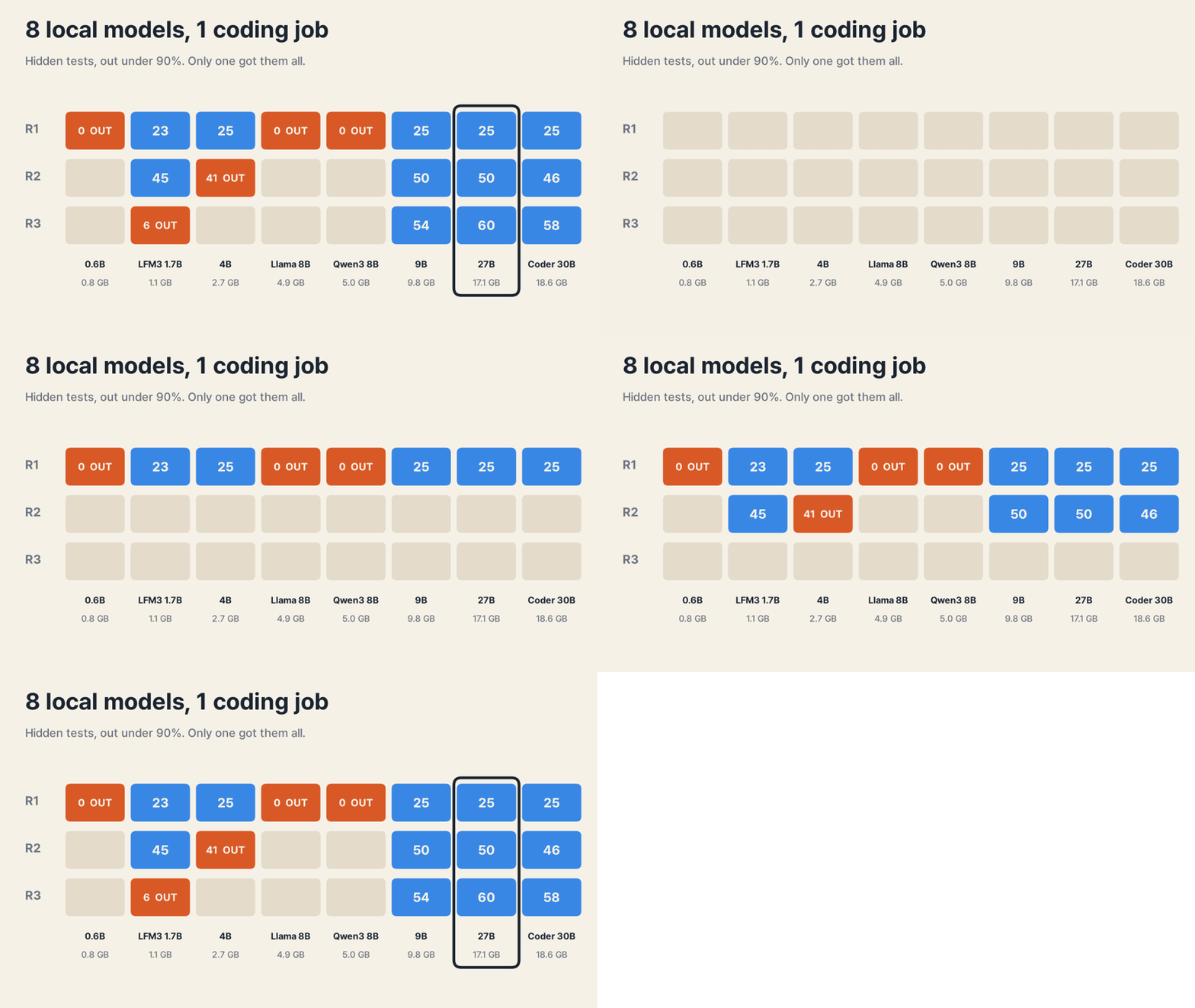
In round one, Llama 3.1 8B finished in 3.0 seconds. It never opened the starter file, wrote its own shipping_fee(weight, zone, express=False) while the file and tests used kg, watched both public tests crash, and replied DONE. Qwen3 8B did read the file, then wrote the same broken file seven times in a row. Both 8B models scored 0 out of 25 on the hidden tests. LFM3 1.7B, a 1.1 GB file, failed the public tests twice, passed on its third try, and scored 23 out of 25. The pass line was 23.
That is the shape of the whole tournament. We gave eight local models, from 0.8 GB to 18.6 GB, the same coding job across three rounds that got harder each time. A model survived a round by scoring at least 90% of the hidden tests in two of three runs. Model size predicted the winner, but it did not predict the order of elimination. And in the last round, the public tests the models could see stopped telling them anything: all three finalists passed 5 out of 5, and only one was right on all 60 hidden cases.
Here's what we found:
- Both 8B models were out in round one with 0/25, for two different reasons: Llama 3.1 8B didn't read the file, and Qwen3 8B couldn't get past a syntax error it wrote itself.
- LFM3 1.7B (1.1 GB) landed exactly on the line twice, 23/25 and 45/50, and outlasted both 8Bs and the 2.7 GB Qwen3.5 4B. It fell to 6/60 when the membership document arrived in round three.
- Passing every public test meant little in the final. Qwen3.5 9B (54/60), Qwen3-Coder 30B-A3B (median 58/60) and Qwen3.6 27B (60/60) all passed 5/5. The perfect one took the longest, about 45-47 seconds against 14-15 for the coder.
This is one task in one harness we wrote. It is not a general coding ranking.
The job and the rules
The task comes from our earlier multi-agent experiment: a made-up online store, Kestrel Supply, with its rules in three policy documents (shipping, returns, membership). Every rate and rule is invented, so no model can answer from memory. The model turns the rules into Python functions in kestrel.py.
It runs as a single agent with three tools: read_file, write_file, and run_tests. run_tests runs a handful of public tests the model can see. The grade comes from hidden tests it never sees, run on whatever file exists when the agent stops (python -I, 20-second limit). A run ends when the model replies without a tool call or after 15 steps.
| Round | Job | Documents | Public tests | Hidden tests | Pass line |
|---|---|---|---|---|---|
| 1 | shipping_fee only | shipping | 2 | 25, basic customers | 23 |
| 2 | shipping_fee, delivery_days, refund | + returns | 4 | 50, basic customers | 45 |
| 3 | same three, with Silver and Gold benefits | + membership | 5 | 60 | 54 |
Settings were fixed for every model: llama.cpp 0.9.0-dev (build 947, commit 3de52ac38), one A100 80 GB PCIe, all layers on GPU, flash attention on, temperature 0, seeds 42, 43 and 44 for the three runs, 4,096 output tokens per call, thinking mode off, 32,768 context. A reference implementation built on the task's answer calculator scores full marks in every round.
The rules were written before the main run, and the plan's change log records two harness fixes made during smoke tests. A tool call cut off at the 4,096-token limit is not executed; the model is told it was cut off, and the run continues. And every run saves its full conversation. Both apply to all models.
The contestants, smallest file first (GB here means 10⁹ bytes, from the file sizes on disk):
| Model | GGUF | File size |
|---|---|---|
| Qwen3 0.6B | Q8_0 | 0.8 GB |
| LFM3 1.7B | Q4_K_M | 1.1 GB |
| Qwen3.5 4B | Q4_K_M | 2.7 GB |
| Llama 3.1 8B Instruct | Q4_K_M | 4.9 GB |
| Qwen3 8B | Q4_K_M | 5.0 GB |
| Qwen3.5 9B | Q8_0 | 9.8 GB |
| Qwen3.6 27B | Q4_K_M | 17.1 GB |
| Qwen3-Coder 30B-A3B Instruct | Q4_K_M | 18.6 GB |
The scoreboard
Hidden-test scores for each of the three runs:
| Model | Round 1 (/25) | Round 2 (/50) | Round 3 (/60) | Result |
|---|---|---|---|---|
| Qwen3 0.6B | 0, 0, 0 | out in round 1 | ||
| LFM3 1.7B | 23, 23, 23 | 45, 45, 45 | 6, 6, 6 | out in round 3 |
| Qwen3.5 4B | 25, 25, 25 | 41, 41, 41 | out in round 2 | |
| Llama 3.1 8B | 0, 0, 0 | out in round 1 | ||
| Qwen3 8B | 0, 0, 0 | out in round 1 | ||
| Qwen3.5 9B | 25, 25, 25 | 50, 50, 50 | 54, 54, 54 | third |
| Qwen3.6 27B | 25, 25, 25 | 50, 50, 50 | 60, 60, 60 | winner |
| Qwen3-Coder 30B-A3B | 25, 25, 25 | 49, 46, 46 | 54, 58, 58 | second |
At temperature 0, the three seeds mostly produced identical runs. So "three runs" is closer to one run checked three times than to three independent samples. The coder was the only model whose hidden score changed between runs in a round it survived.
Round one: two 8Bs out, a 1 GB model on the line
Qwen3 0.6B behaved differently across seeds, but it scored zero in every run. In the first run, its opening reply hit the 4,096-token cap before it called a single tool, and then it replied DONE. In the other two, it read the file and overwrote it with a 90-character stub, def shipping_fee(weight): followed by two comments.
Llama 3.1 8B did the same two moves in all three runs: write_file, then run_tests. It never called read_file, so it never saw that the starter signature is shipping_fee(kg, zone, ...). Its version took weight, and both public tests failed with a TypeError about the unexpected keyword argument kg. It then replied DONE. The whole run took 2.6-3.0 seconds.
Qwen3 8B read the file first. The file it wrote dropped the opening triple quotes of the docstring on the first line, so Python could not import it. We pulled the raw completion from the server to check whether the engine's tool-call parsing had eaten the quotes. It hadn't: the model wrote it that way. It wrote that same file seven times in all, ran the public tests after each write, saw 0/2 every time, and hit the 15-step limit. That's a model failure in this engine and template, not a parsing bug.
LFM3 1.7B went write_file → run_tests 0/2, then the same again, then 2/2 on its third attempt. Its hidden score was 23/25 in all three runs, exactly the pass line. A 1.1 GB file outlasted two files more than four times its size (4.9 and 5.0 GB). The 4B, 9B, 27B and coder all scored 25/25, so five models went on.
Round two: the 4B passes its tests and still fails
Round two added delivery_days, refund and the returns policy. Qwen3.5 4B scored 2/4 on the public tests, had one reply cut off at the token cap, scored 2/4 again, then 4/4. Its final message began: "All 4 tests pass. The implementation follows Kestrel Supply's shipping and returns policies exactly." Its hidden score was 41/50, under the line of 45.
Eight of its nine misses were shipping fees, from one rounding rule. The shipping policy says weight is rounded up to the next 0.1 kg. The 4B rounded to the nearest, round(kg / 0.1) * 0.1. A 10.03 kg parcel should become 10.1 kg, which falls in the heavier bracket and costs $39.70; the 4B's code made it 10.0 kg and charged $29.50. The public tests used whole-kilogram weights only, so they could not catch this.
LFM3 1.7B scored 45/50 in all three runs, again exactly on the line. The coder dipped to 49, 46 and 46 but stayed above 45. The 9B and 27B scored 50/50 every time. Four models went on.
Round three: three finalists pass every visible test
Round three added the membership document. Silver and Gold members get discounts on shipping and returns, so all three functions change.
LFM3 1.7B fell apart. It wrote 7,829 characters, scored 0/5 on the public tests, rewrote, scored 0/5 again, and then called run_tests six times in a row without changing the file. It used all 15 steps and 160,448 tokens, and scored 6/60 on the hidden tests.
The other three each made exactly the same four calls: read_file, write_file, run_tests with 5/5 passed, then a final answer. If the public tests were the grade, it would be a three-way tie. The hidden tests separated them:
| Finalist | Public | Hidden (3 runs) | Wall time, run 1 | Where it lost points |
|---|---|---|---|---|
| Qwen3-Coder 30B-A3B | 5/5 | 54, 58, 58 | 15.3 s | refunds: 6 in run 1, 2 in runs 2 and 3 |
| Qwen3.5 9B | 5/5 | 54, 54, 54 | 22.0 s | 6 shipping fees |
| Qwen3.6 27B | 5/5 | 60, 60, 60 | 46.7 s | none |
The times are for reference only. Another job could share the server, and Qwen3 8B's identical round-one runs took anywhere from 38.7 to 154.6 seconds. The ordering of the three finalists held in all three runs, though.
The 9B rounded weight up with round((kg + 0.0999999) / 0.1) * 0.1. That pushes values that are already exact up one step: 30.0 kg became 30.1 kg, and its own code then rejected the parcel as over the 30 kg limit. A parcel of exactly 2.0 kg became 2.1 and was billed as heavier.
The coder got refunds wrong. One line was 0.18 if tier == "basic" else 0.09, which gives Silver members the Gold half-rate restocking fee. The membership policy says Silver members have no restocking or label benefit. For $480 of opened furniture returned by a Silver member, the answer is $386.10, and the coder refunded $429.30.
The 27B scored 60/60 in every run of every round.
The final round that changed nothing
Three models were left, so the pre-registered rules called for more rounds: the round-three job again at 12,288 tokens of context, then at 8,192, to simulate a smaller card. Nobody came close to either limit. The largest single request any finalist made, prompt plus output, was 6,260 tokens (9B), and the server rejected zero requests. Every score matched round three exactly. Those rounds were a re-run, and they say nothing about small cards.
The tiebreak was the median hidden score: 54 for the 9B, 58 for the coder, 60 for the 27B.
What this does and doesn't show
- One task, one harness. Every model got the same system prompt, tools and step limit, which we wrote. A different task or agent loop could reorder the middle of the table.
- Tool calling depends on llama.cpp's chat template handling. The round-one failures are failures in this engine with these templates. For Qwen3 8B, we checked the raw output and confirmed that the model wrote the broken line itself.
- Public tests were few: 2-5 per round against 25-60 hidden. In rounds two and three, models that passed every visible test still missed 2 to 9 hidden cases. In this setup, "the tests pass" in a model's final message told us nothing about the hidden grade.
- Speed and accuracy pulled in opposite directions among the finalists. The most accurate model was about three times slower than the coder here. The coder is a mixture-of-experts model with about 3B active parameters. We measured wall time on a shared GPU and didn't try to isolate why.
The video version follows the same runs round by round. Subscribe below for the next experiment.