Before mapping thought: 18 of 128 step labels changed when markers disappeared
We collected 16 local reasoning traces, checked annotation stability and compared transitions with shuffled order. Marker removal changed 18/128 comparable labels; this is a measurement audit, not a Mole-Syn training replication.
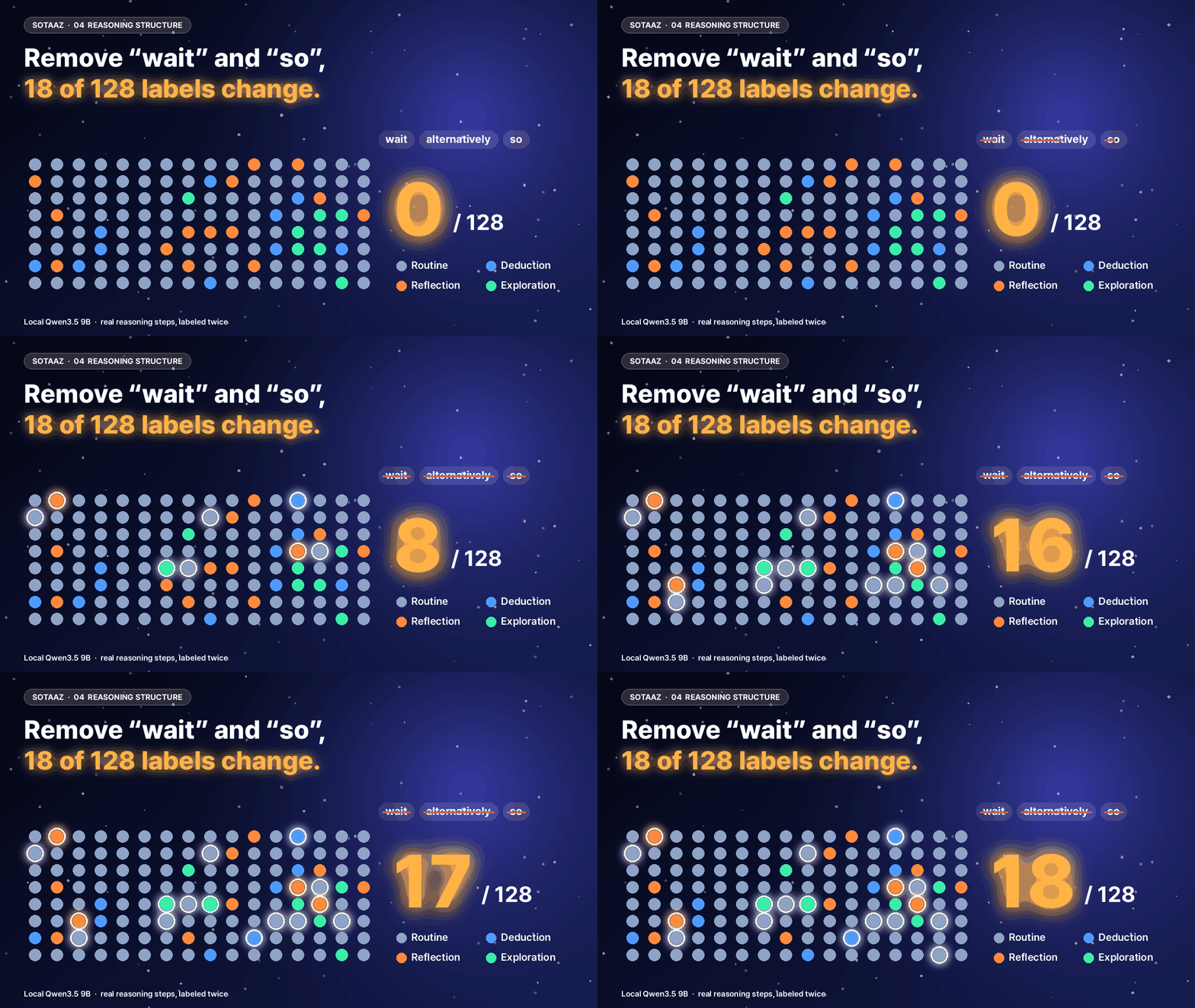
Removing discourse markers changed 18 of 128 comparable step labels in our local reasoning traces. A calculation became “exploration”; a verification became “routine operation.” We used the same annotator at temperature zero. The map still changed when the wording changed.
This was a small text-annotation experiment, not direct access to a model's internal computation. It gives us a concrete measurement issue to carry into The Molecular Structure of Thought: before interpreting a transition map, inspect how the steps and labels were produced.
Collecting actual traces, including unfinished ones
We ran qwen3.5:9b through Ollama with Q4_K_M weights, a 24,576-token context, thinking enabled, temperature 0.6 and a 1,024-token generation cap. The checkpoint metadata reports approximately 9.7 billion parameters. Eight predetermined arithmetic and inventory questions were each run with seeds 101 and 202. Python computed the answer keys before inference.
The questions were the first eight from a previously generated list; we did not select interesting traces after seeing outputs. Paragraph boundaries defined steps, with line splitting as a fallback when fewer than three paragraphs were present. This produced 171 steps from 16 traces.
Nine generations hit the output cap. Seven produced a correct final answer. Those numbers are conditional on a restrictive output budget, not a broad arithmetic benchmark. Several traces spent their allowance checking interpretations before reaching a final answer.
We kept truncated traces. Discarding them would select for reasoning that finishes quickly. Keeping them means our transition map contains prefixes of incomplete trajectories, a limitation that must accompany the figure. Completion policy affects the object being measured.
An annotation is another model output
The same model classified steps with thinking disabled, temperature zero and a 768-token output cap. We asked for N for routine calculation or restatement, D for a nontrivial deduction, R for checking or correcting an earlier assumption, and E for trying an alternative path. It returned an array with one label per step.
We annotated each trace twice: once unchanged, once after removing a fixed list of markers including “wait,” “however,” “alternatively,” “maybe,” “perhaps,” “let me,” “let us,” “double-check,” “actually,” “but” and “so.” The intervention preserved step boundaries and did not intentionally change numbers or equations. Removing connectives can still alter grammar and meaning, so this is not a perfectly semantics-preserving transformation.
Only 25 of 32 annotation responses had the required length and valid label vocabulary. We compared a trace only when both variants had valid arrays. Among those 128 steps, 110 labels agreed and 18 differed: 85.9% agreement. This measures consistency between two annotations, not accuracy against human ground truth. We did not create an independent human label set.
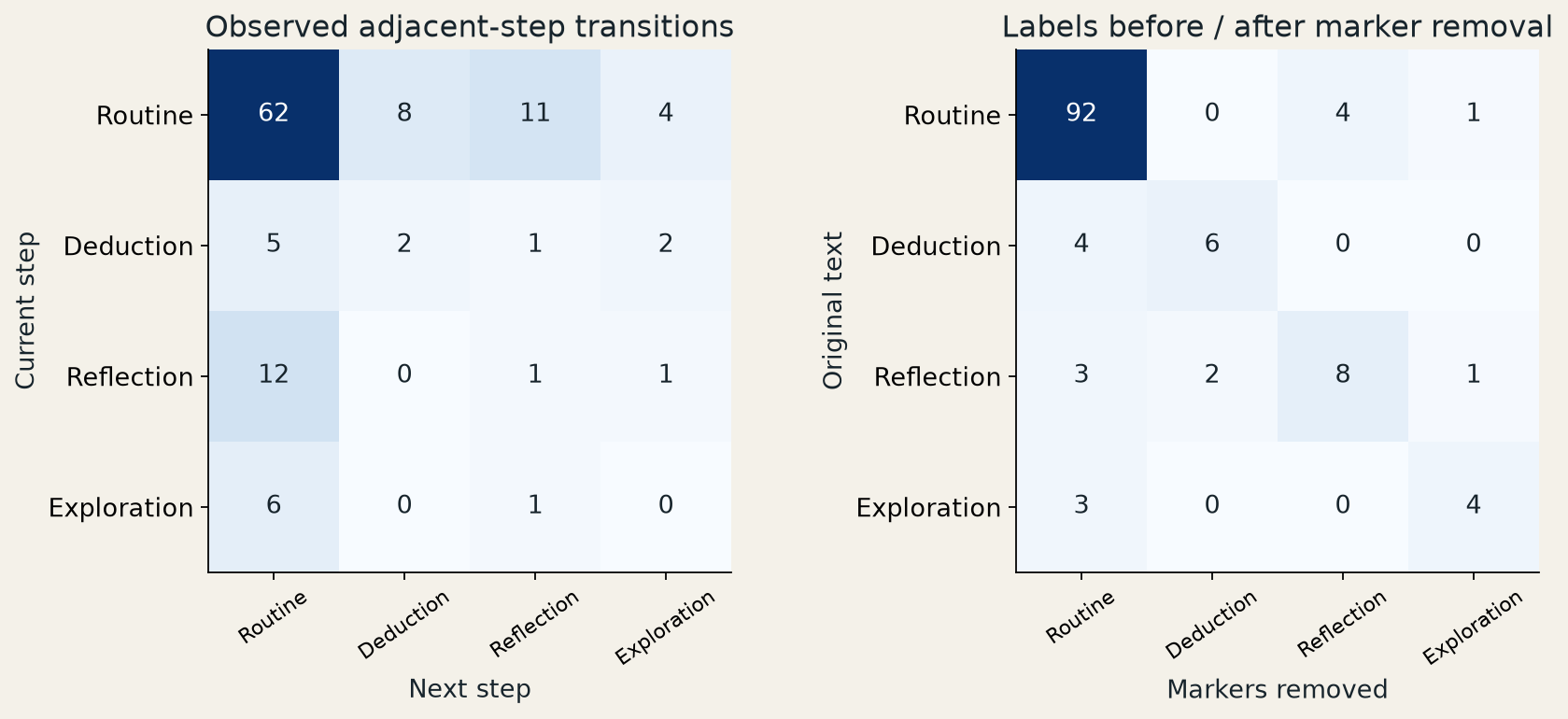
One verification step in inv-04, seed 101, included the correction 972 - 862 = 110, wait. 972 - 860. The original annotation called that step N; the marker-removed annotation called it R. The direction is not simply “remove wait, lose reflection.” The annotator receives the whole trace, so changes elsewhere can affect the label too.
In another trace, a step about constructing the final JSON response changed from E to N. Routine formatting is our more natural reading. These cases are why we release the text alongside the labels: a plausible behavioral taxonomy does not guarantee that a model applies it reliably.
A diagonal-heavy matrix needs a composition control
Valid original annotations supplied 116 adjacent step pairs. Sixty-five repeated the same label, a self-transition rate of 56.0%. That can look like sustained behavioral phases. But a dominant routine-operation label creates repeated neighbors even when ordering contains little information.
We therefore shuffled label order within each trace while retaining its length and label counts. Across 1,000 shuffles, the mean self-transition rate was 59.0%, with a central 95% range of 54.3–63.8%. The observed 56.0% fell inside that range.
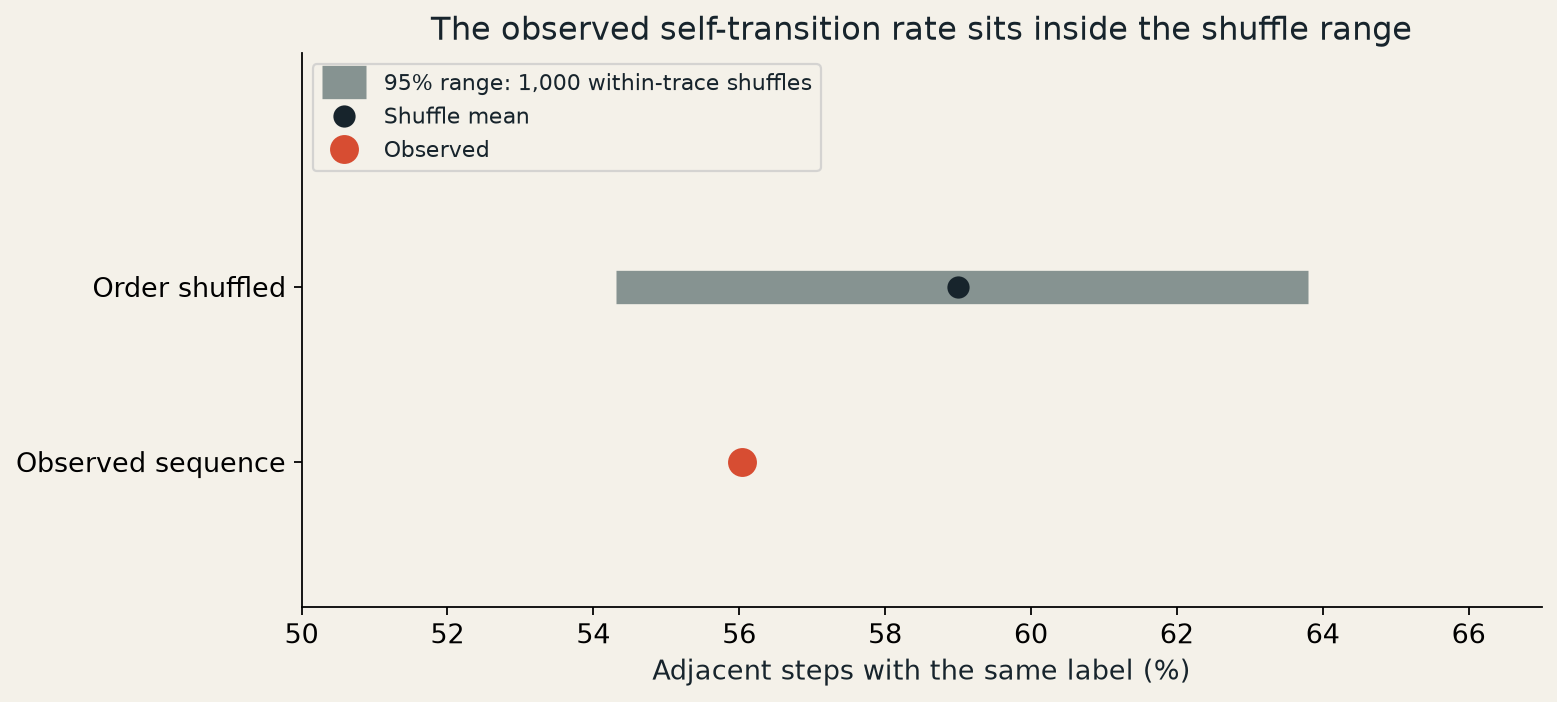
For this statistic and this dataset, the diagonal alone does not establish a special ordering pattern. It also does not establish that reasoning is random. We did not test every transition, long-range dependence or problem-specific sequence. A single summary statistic cannot settle those questions.
Nor does this challenge the paper's student-training results. Our model, tasks, segmentation and annotator differ, and we did not train a student. The experiment isolates an earlier interpretive step: separating label prevalence from information carried by order.
What this changes about a follow-up experiment
Noisy labels can still produce useful training data. The relevant question is whether the particular ordering policy adds value beyond label frequency, answer filtering and token budget.
A stronger follow-up would compare transition-guided synthesis, synthesis with matched behavioral frequencies but shuffled order, and synthesis without explicit transition guidance. Teacher information, generated tokens, acceptance filters and student training would need comparable budgets. That is an experiment proposal, not a result from this run.
Our immediate contribution is smaller and executable: count truncations and invalid annotation arrays, inspect actual labels, and compare observed ordering with a composition-preserving control. Those checks make it easier to interpret an expensive training experiment later.
Reading the paper beyond our local test
Qiguang Chen and colleagues at ByteDance Seed, Harbin Institute of Technology and collaborating institutions study more than text labels in The Molecular Structure of Thought. Their paper includes hidden-representation analysis, attention analysis, data synthesis and student training. Our limited test should not stand in for that larger body of evidence.
A long answer contains different kinds of steps
A model solving a problem may derive a new relation, check an earlier assumption, and try a different route. The output is sequential text, but the role of each step differs.
The paper organizes important behaviors into deep reasoning, self-reflection, and self-exploration. The operational classification and the Mole-Syn transition process also include normal operation, covering routine calculation and execution of an already chosen plan.
| Behavior | Role in a solution | Molecular analogy |
|---|---|---|
| Deep reasoning | Introduce logical relations and intermediate conclusions | Covalent bonding |
| Self-reflection | Revisit assumptions or check earlier work | Hydrogen bonding |
| Self-exploration | Try alternative hypotheses or solution paths | Van der Waals interactions |
| Normal operation | Perform routine calculations or progression | Basic procedural behavior |
These are analytical categories, not four physical components discovered inside a model. The method segments reasoning and labels what the steps are doing.
For example, noticing that an earlier positivity assumption excludes zero would be a reflective move. Switching from case analysis to a symmetry argument would be an exploratory move. Those are examples we constructed to explain the categories, not outputs collected from a model.
This distinction gives a richer description than answer length alone. A long response can contain repeated paraphrases, useful checks, or an unproductive branch. Counting tokens does not separate those behaviors.
What was actually mapped?
The study analyzes several objects. It estimates behavior distributions and transitions in generated reasoning. It also studies hidden representations and attention, so describing it as only a count of output words would be inaccurate.
For step-level geometry, the method encodes textual steps using hidden states from a reference encoder, pools token representations, and examines reduced-dimensional representations. The paper uses three-dimensional t-SNE visualizations in its semantic-space analysis. It also compares hidden-state features before and after supervised fine-tuning using a sparse autoencoder, and examines attention logits across behavior types.
A point in a reduced-dimensional plot is not a neuron or a literal spatial location. It is the output of an encoding, pooling, and projection procedure. A path returning toward an earlier cluster is an observation about that representation. It does not recover every internal computation that produced the answer.
To use this analysis elsewhere, we would want to record the encoder, layer, segmentation method, behavior classifier, and projection settings. Different segmentation can change the number of transitions. Different representations can change the geometry. Those are measurement choices worth testing, not details to omit once a striking picture exists.
Do models just learn words such as “wait”?
One useful intervention in §4.2 changes discourse markers in training traces. The researchers ask whether a model is learning the markers themselves or the reasoning behaviors associated with them.
They compare data in which markers are replaced with alternatives or removed while the reasoning trajectories are preserved. The paper reports that explicit markers can accelerate learning but are not essential for comparable reasoning performance with sufficient training.
This is a more specific result than a claim that adding a special word to a prompt creates reasoning ability. It changes part of the training data and examines the resulting learning behavior. It still applies to the paper's tested conditions; it is not a universal statement about all models and tasks.
For training-data design, the useful question is what the solution actually does. Two equally long traces may differ substantially if one checks a relevant assumption and the other merely repeats it.
Mole-Syn uses a transition distribution
Mole-Syn uses the analysis to guide data synthesis. The researchers estimate how reasoning behaviors transition in traces from stronger reasoning models. They then prompt an instruction-following model to continue a solution in a selected behavioral state, sampling transitions through a behavior graph.
The appendix provides prompts for reflection, exploration, and normal operation. The generated trajectories become training data for a student model, which is evaluated on reasoning tasks and in subsequent reinforcement learning.
The method is therefore more structured than asking a model to reflect at every step or simply to write longer answers. It controls the kind of continuation requested according to an estimated transition process.
It also does not eliminate information from stronger reasoning models. Appendix 15.1 describes estimating the transition matrix from teacher-generated reasoning data. Directly copying all of a teacher's prose and transferring a distribution estimated from that prose are different approaches, but both can depend on teacher information.
A local reproduction should compare the estimated transition policy with random behavior selection while controlling generation tokens, attempts, filtering, and student training exposure. Otherwise, an apparent structure benefit could partly reflect longer traces or different data quality. We did not run that controlled training comparison for this article.
What the molecular vocabulary does not establish
Attention weights are obtained by applying softmax to logits. A Gibbs–Boltzmann distribution likewise uses an exponential and a normalization term. The paper treats negative logits as an energy-like quantity and examines how it varies across behavior categories. This is a defined analysis quantity, not a measurement of chemical bond energy.
Likewise, observing clusters and returns in a reasoning representation does not establish a universal detector that identifies hallucination before an answer is emitted. Such a detector would need evaluation on correct and incorrect trajectories, with false positives and missed errors measured on unseen tasks.
A claim that we now know the complete internal shape of AI thought expands the scope beyond the tested objects. This paper investigates particular models, traces, behavior labels, representations, and training procedures. Keeping those objects explicit makes its results easier to use.
The paper's internal analyses should not be dismissed, but they should not be extended into a complete mechanistic account merely because the visual analogy is memorable.
Reproduction materials
The download contains actual traces, both annotation variants, prompts, validity checks and the shuffle analysis. Offline analysis requires no model. We did not train a student or extract hidden states.
Updated November 16, 2026: added real traces, annotation stability and a composition-preserving transition comparison.
Sources
- The Molecular Structure of Thought v2: behavior definitions, marker interventions, representation and attention analysis, and Mole-Syn.
- arXiv record and author list.
Subscribe below for research readings that distinguish measured results from their public descriptions.
Files for this post
Reproduction package
The harness, raw logs and result CSVs behind this post. No account needed; the README has a command that recomputes the tables without a GPU.
molecular-structure-thought-repro.zip · 4,673 KB