Fixing OpenMausBot's Scheduled Brief on a Local Model: What 0.1.169 Repaired and What It Didn't
In part 1, zero of six scheduled tech briefs reached the chat. With OpenMausBot 0.1.169 and no other change, four of six arrived on time and every fact we checked matched. The two failures ended on the same empty tool call, and five of nine delivered briefs had a link that was not a page the bot had fetched in that run.
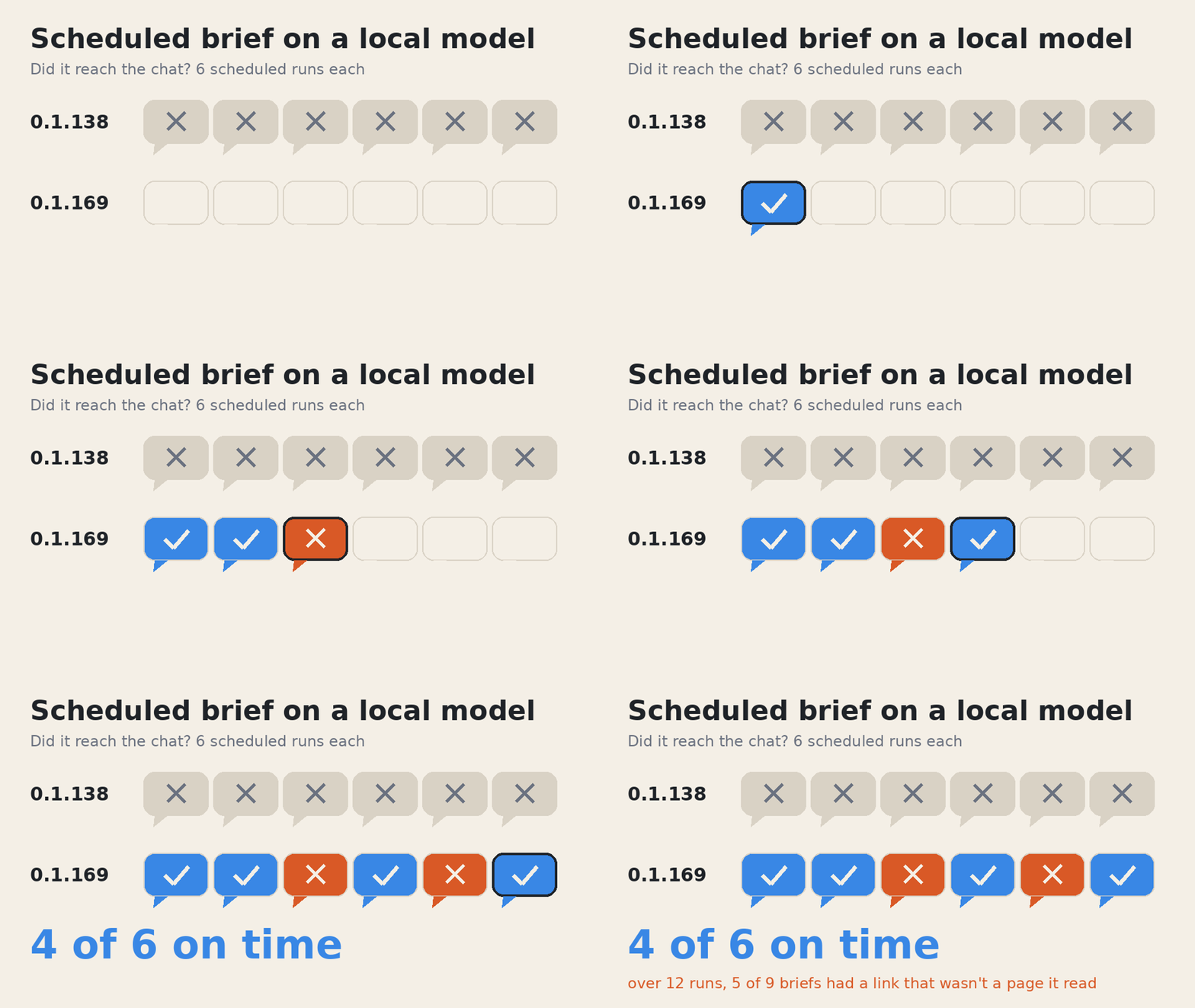
Getting a scheduled job to work on a local model is harder than it looks. In part 1, our bot wrote a tech brief inside five of six scheduled runs, and not one of them reached the chat. This time we updated OpenMausBot from 0.1.138 to 0.1.169 and changed nothing else: four of six briefs arrived in the chat 6 to 10 minutes after the scheduled time, and every name and number we checked in them matched the pages the bot had fetched.
That still did not pass our bar. Both failed runs ended on the same empty tool call. For a second set of six we turned on the app's loop guard, and it never triggered once. In five of the nine briefs that did arrive, at least one of the five links was not a page the bot had fetched in that run.
This post is written as a repair log: the defects part 1 left, what the new version changed in the code, the two sets of runs, and a verdict for each defect.
What we count as working
A run can look fine in three different places, and part 1 showed they do not always agree. So we count three things for each scheduled run:
- Delivered on time. The brief itself appears in the bot's chat within 15 minutes of the scheduled time. A notice line such as "This run didn't finish" does not count.
- Record matches the result. The app marks the run completed exactly when a brief reached the chat.
- Links were fetched. Each of the five links in a delivered brief is a page the bot downloaded in that same run. We check this against the curl commands and their output in the run's tool log.
We also checked names and numbers in every delivered brief against what the bot's tools returned. A set of six runs passes if at least five are on time, every link in every delivered brief was fetched, and the record never disagrees with the chat.
The defect log from part 1
| Defect | What happened in part 1 |
|---|---|
| SQ-1 | One tool call failing during a turn marked the whole run failed, and the brief never reached the chat (5 of 6 runs) |
| SQ-2 | The model printed a tool call as text, the app marked the run completed and posted that text (1 run) |
| SQ-3 | Briefs written by MausBot's retries did not reach the chat either (3 runs) |
| SQ-4 | OpenMausBot could not read Strata's context limit and assumed 128K (first browser run) |
What 0.1.169 changed in the code
We compared the server code of the two versions before running anything. This section is what the code says, not what we saw the model do.
SQ-1. In 0.1.138, a failed tool result set a flag for the turn. If the model then finished with an answer and no tool call, the flag was still set and the app threw the turn away as a tool error. The run was recorded as failed, and a failed run posts only a one-line notice to the chat. In 0.1.169 the flag is cleared when the bot runs tools again. A comment in the source says a failure "stays pending only until the bot runs tools again". A failure in the last calls of a turn still ends it.
The new version also treats a model on a local address as a local model. For those it allows at least two corrective rounds: when the model tries to finish right after a failed call, the app hands it the error and asks again. Failed runs now also get a new line in the chat saying the run "was partly done".
SQ-2. For local models, 0.1.169 holds back text that looks like a tool call, and if it cannot read the call, it asks the model once more.
SQ-4. The new version reads a few more fields for the context limit, but not the one Strata uses. In part 1 the shell brief never came close to this limit. One run in this post did reach it, and we come back to that in the verdict.
The setup
The engine is the one from part 1 and part 2: Strata in Docker, the same image, serving Qwen3.8-Flash-Next IQ2_XS with a 128K context (131,072 tokens) and two slots, on one A100 80GB with vram-reserve-mib=71300. We copied part 1's app data, installed 0.1.169 next to it, and kept the bot Brief2 with its Local VM and shell.
The prompt is part 1's, word for word: every 25 minutes, fetch the first 15 items from the Hacker News front page, GitHub Trending and arXiv's new cs.AI list with curl, pick five, fetch each pick and summarize only what that page says, with its link. The 25-minute interval is only so we could see six runs in a morning. All times below are Korea time.
We ran two sets of six on November 24:
- A, 09:01 to 11:27: 0.1.169 as installed.
- B, 11:31 to 13:57: two fixes aimed at the failures in A.
For B we turned on the app's loop guard with one more corrective round than the local default, in the app's config.json:
"loopGuard": { "enabled": true, "correctiveRounds": 3 }and added two sentences to the end of the prompt:
Fetch all three list pages with one shell command. If a command fails, run a corrected command before you write the brief.Check A: the update alone
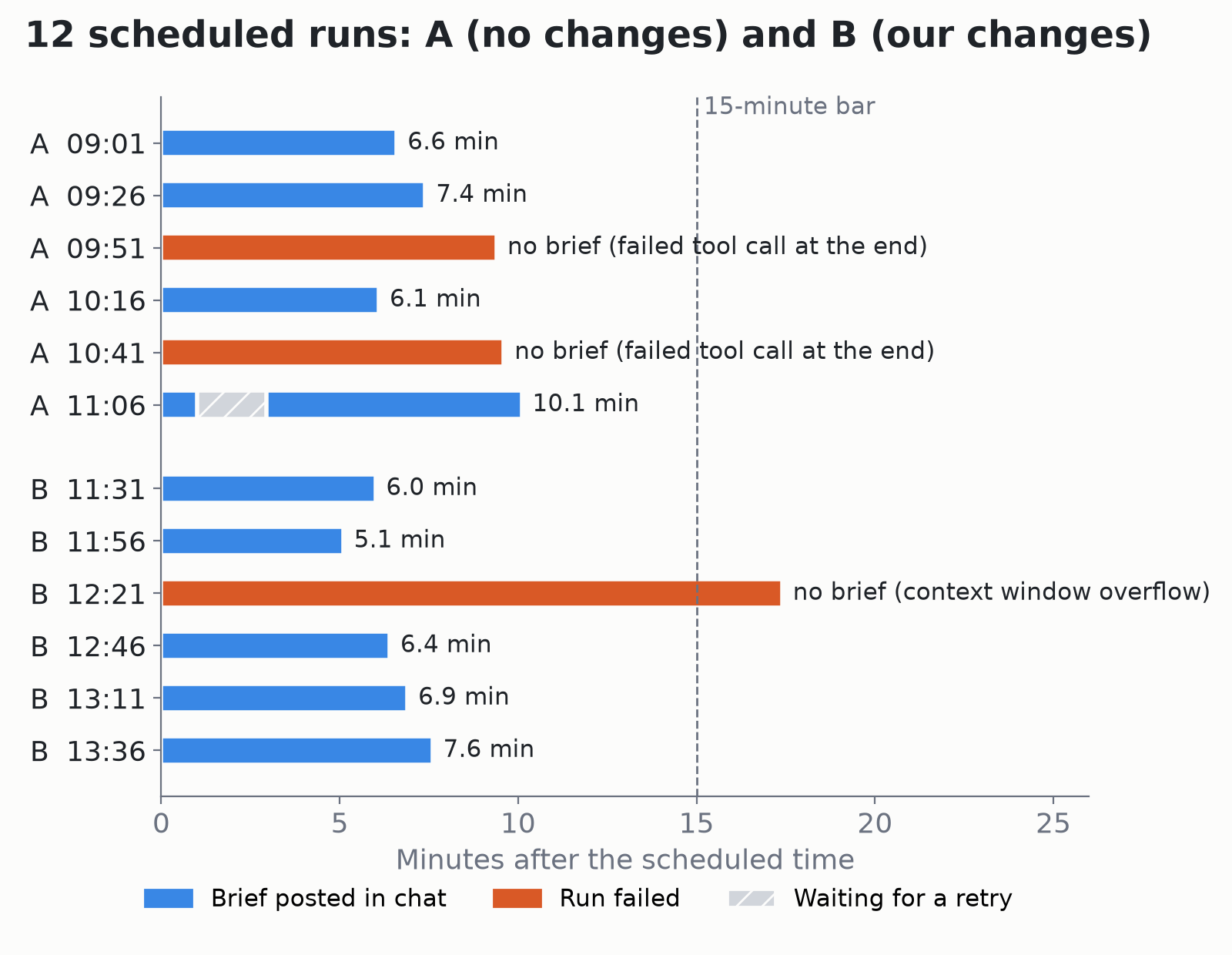
| Scheduled | Result | Minutes to chat | Tool calls (failed) | Links fetched |
|---|---|---|---|---|
| 09:01 | brief in chat | 6.6 | 23 (1) | 5 of 5 |
| 09:26 | brief in chat | 7.4 | 39 (11) | 5 of 5 |
| 09:51 | failed | none | 42 (10) | |
| 10:16 | brief in chat | 6.1 | 28 (1) | 5 of 5 |
| 10:41 | failed | none | 40 (13) | |
| 11:06 | brief in chat | 10.1 | 29 (6) | 4 of 5 |
Four of six were on time. Every completed run posted its brief, and every failed run posted only a notice, so the record matched the chat in all six.
The 09:26 run is the SQ-1 change at work. Eleven of its 39 tool calls failed along the way, and by the 0.1.138 code above any one of them would have sunk the run. Here the bot kept running tools after each failure, and the brief arrived at 7.4 minutes. The first on-time brief of the day, at 09:01, looked like this (first two picks):
Tech brief — 24 Nov 2026 (fetched with curl from HN front page, GitHub Trending, arXiv cs.AI)

Hacker News
- Stalwart is now a drop-in Exchange replacement — Stalwart 1.2.0 implements
  MAPI-over-HTTP, EWS, Exchange ActiveSync and Autodiscover, so Outlook/Apple
  Mail/mobile clients connect unchanged ... https://stalw.art/blog/microsoft-exchange-replacement/
- Ladybird enters alpha — its from-scratch (non-fork) engine is now downloadable
  for macOS and Linux as a rolling auto-update channel ... https://ladybird.org/posts/alpha/
The two failures look alike. In both, the model wrote the whole brief, but in the same reply it also called agents_use_tool with no arguments. That tool is a bridge OpenMausBot gives the bot to reach its other tools by name, so a call without a name cannot do anything, and the app answered "Tool arguments do not match the advertised input schema". The app then ran its two corrective rounds. Each time the model wrote the brief again and sent the same empty call with it. The last call of the turn had failed, so the run failed, and the chat got:
This run was partly done: Stopped because the tool call "agents_use_tool" failed. The bot's reply isn't proof the work was done; the failed step shows the error.
The empty call was 7 of the 10 failures at 09:51 and 9 of the 13 at 10:41. MausBot then retried both runs on its own, once and twice, and those retries did not post to the chat either, which is SQ-3 again. The second retry of 10:41 overlapped the 11:06 run, which waited about two minutes for it and arrived at 10.1 minutes.
Check B: our two fixes
| Scheduled | Result | Minutes to chat | Tool calls (failed) | Links fetched |
|---|---|---|---|---|
| 11:31 | brief in chat | 6.0 | 19 (0) | 2 of 5, 2 can't tell |
| 11:56 | brief in chat | 5.1 | 24 (2) | 4 of 5 |
| 12:21 | failed | none | 95 (69) | |
| 12:46 | brief in chat | 6.4 | 24 (2) | 4 of 5 |
| 13:11 | brief in chat | 6.9 | 22 (1) | 4 of 5 |
| 13:36 | brief in chat | 7.6 | 29 (2) | 5 of 5 |
Five of six were on time, with the record matching the chat in all six. But the loop guard never triggered: across all six runs it warned about a repeated call zero times and ran zero corrective rounds. The model did follow the first added sentence, and in all six runs its first list command fetched all three pages. It already did that in four of six A runs, though, and the added sentences did not stop the failure at 12:21.
The failed run shows why. At 12:21 the model sent the same empty agents_use_tool call 68 times, up to 12 in a row. A run of identical calls is what the loop guard is for, so we went back to the code. Its repeat detector builds a key from the call's title and skips any title with no space or slash in it. An empty agents_use_tool call has only the bare tool name for a title, so it is never counted as a repeat. The corrective rounds did not start either. The code starts them only when the model tries to finish after a failure, and here the model called a tool again every time.
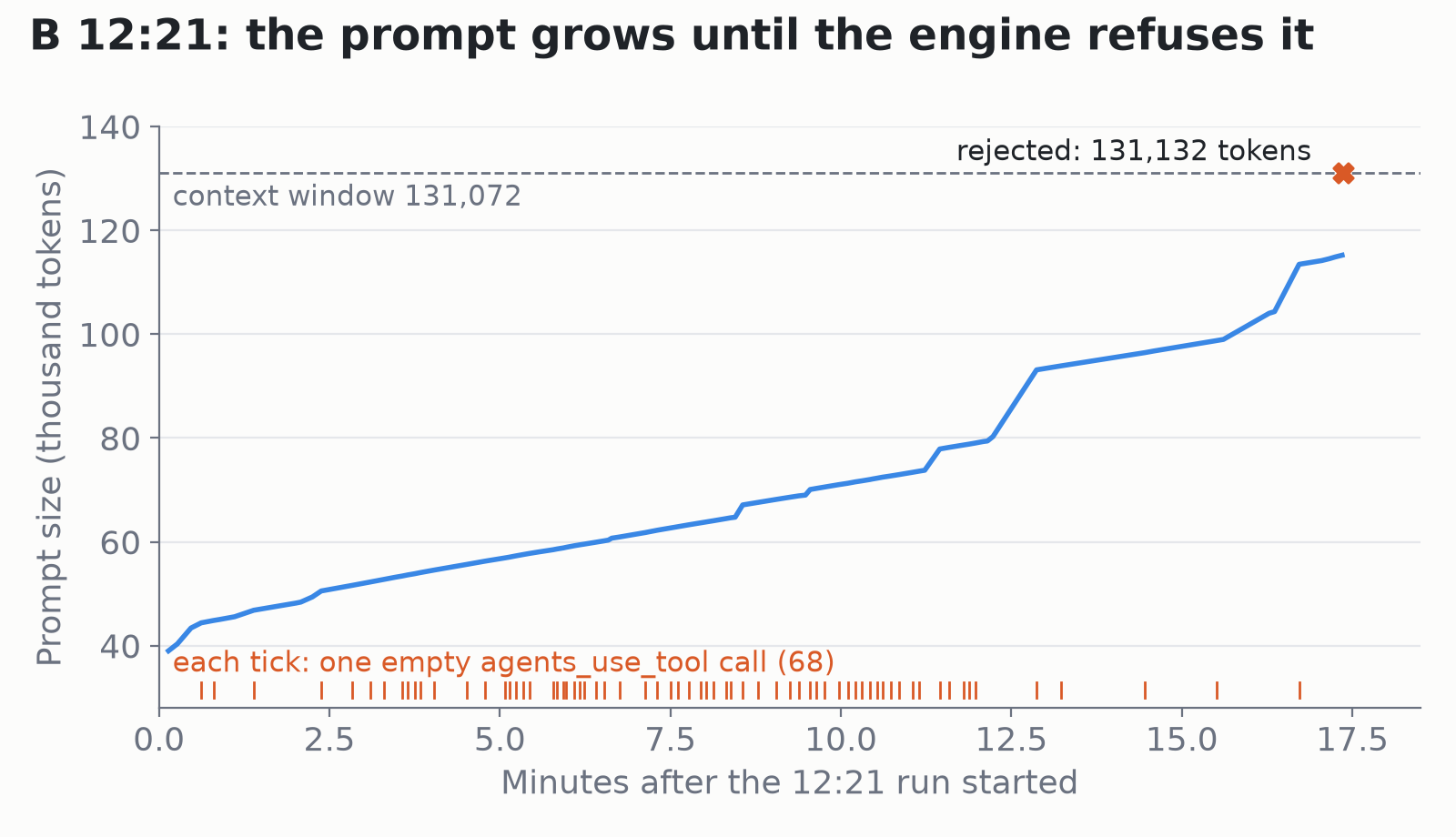
Every call and its result stayed in the conversation, 68 of those calls the empty one, and the prompt kept growing. It started at about 39,000 tokens, and the last request the engine accepted was 115,212. At 12:39:20 the app sent a 131,132-token request, 60 tokens past the 131,072-token window, and the engine refused it. The chat showed "This run didn't finish: upstream HTTP 400: request exceeds the context window".
So we have no grounds to credit our changes for B's 5 of 6 against A's 4 of 6. Six runs on each side is also too few to tell one on-time brief apart from run-to-run variation.
The links
The facts held up. We checked 6 to 10 names and numbers in each of A's four briefs and 11 to 19 in each of B's five, against what the bot's tools returned in that run, and all of them matched.
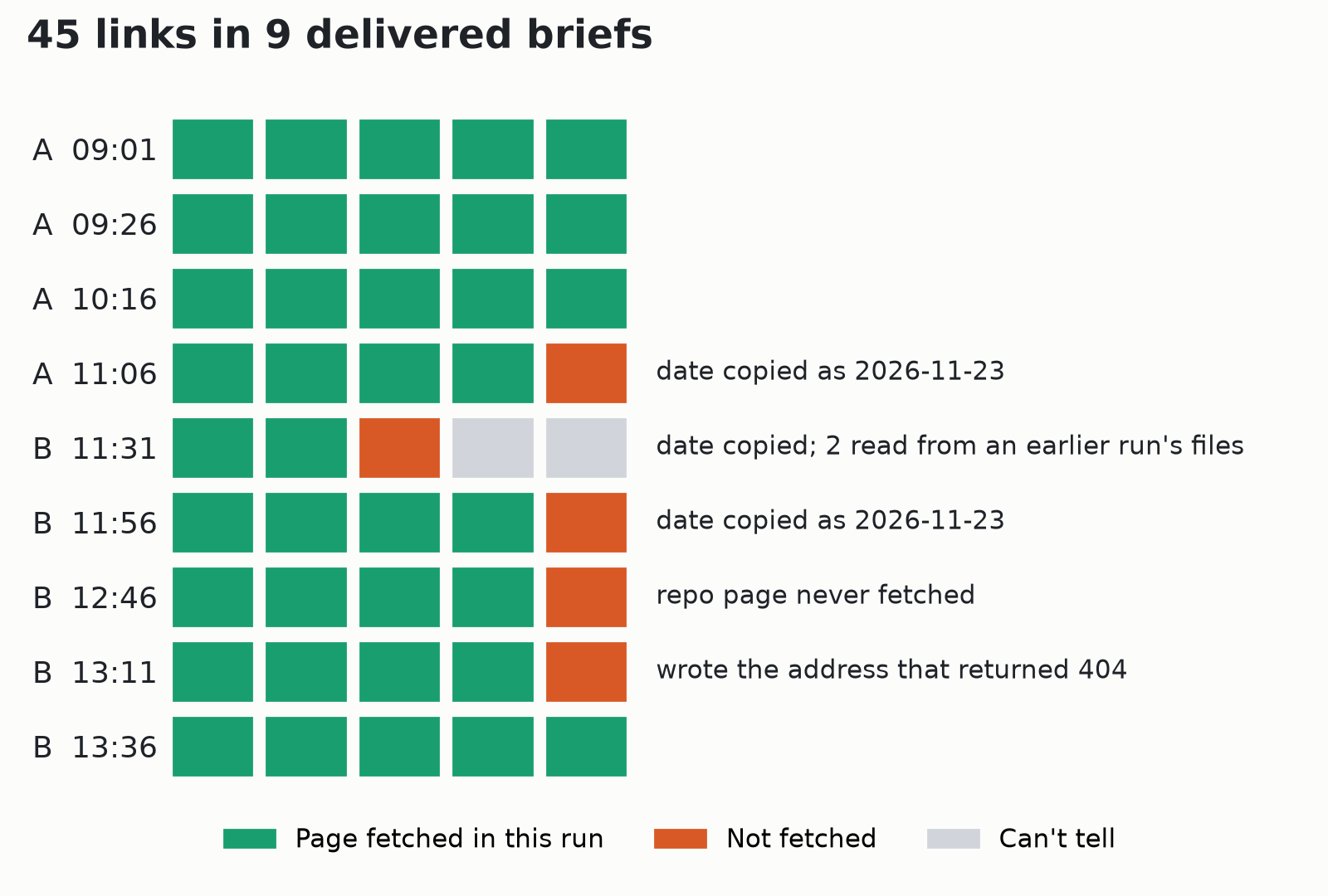
The links held up less well. Only four of nine delivered briefs had all five links fetched in the same run. The misses fall into three kinds:
- Copying the date wrong (3 briefs). The bot fetched
cnbc.com/2026/11/23/nvidia-jensen-huang-ceo.htmland wrotecnbc.com/2026-11-23/...in the brief, which is not the page it read. This happened at A 11:06, B 11:31 and B 11:56. - Keeping the address that failed (1 brief). At B 13:11 the bot tried two forms of one blog address. The form with dashes returned 404, and the form with slashes returned 200. The brief has the dashed one.
- Not fetching the page (1 brief). At B 12:46 one summary was written from its one-line entry on GitHub Trending, and the repository page was never fetched.
The two links we cannot check, at B 11:31, come from our side. That run read two pages from files that an earlier run in set A had saved in the same VM folder, so the page existed but was not fetched in that run.
The verdict
Neither set passes. A misses on time, with four of six, and on links. B misses on links.
| Defect | Verdict after 0.1.169 |
|---|---|
| SQ-1 | Fixed for failures in the middle of a turn (A 09:26). A failure in the last call still sinks the run, and here that last call was the empty agents_use_tool |
| SQ-2 | Not seen. No tool call printed as text reached the chat in 12 runs, and the app's re-ask for unreadable calls never fired |
| SQ-3 | Still open. MausBot retried both failed runs in A, and none of the three retries posted to the chat |
| SQ-4 | Can't be told apart here: the app's assumed 128K equals the 131,072 tokens we gave Strata |
Compared with part 1, the change is large: briefs now reach the chat, and what they say is backed by what the bot read. What is left is the edge of each run: the last tool call, and the link copied into the brief.
What we would do with a local scheduled brief
We would run 0.1.169 or later and not count on the loop guard for this job, since in our runs it never caught the empty call. Before trusting a brief, we would click every link once. The facts matched in all nine briefs, but more than half of them had at least one link that was not the page the bot read, and the most common cause was the bot retyping a dated address in a different form.
In part 4 we cut OpenMausBot off from the internet and see which jobs still work. It will land in the newsletter below.