Agentic RAG Pipeline — Multi-step Retrieval in Production
Build a full Plan-Retrieve-Evaluate-Synthesize pipeline. Unify vector search, web search, and SQL as agent tools. Add hallucination detection and source grounding.
title: "Agentic RAG Pipeline — Bringing Multi-Step Retrieval to Production"
date: "2026-03-09"
series: "agentic-rag"
part: 3
tags: ["rag", "agent", "langgraph", "production", "grounding"]
Agentic RAG Pipeline — Bringing Multi-Step Retrieval to Production
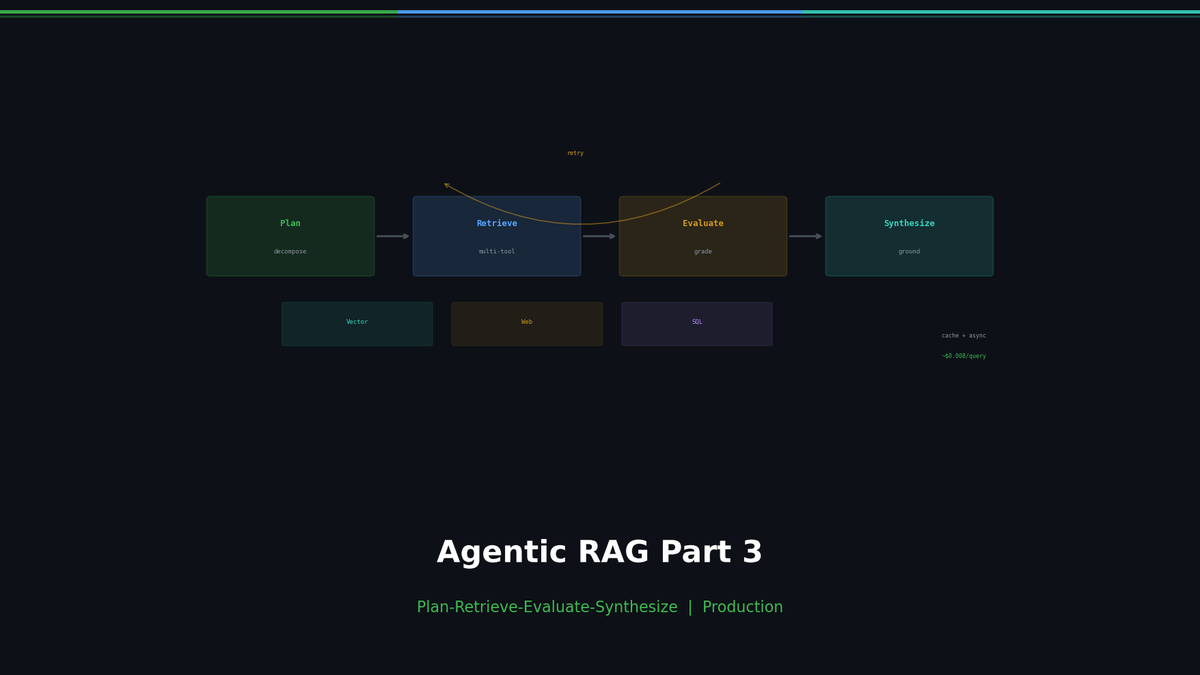
In Part 1, we solved "where to search," and in Part 2, "whether the search results are good enough." But real-world questions rarely end with a single retrieval. Complex queries like "Compare last quarter's revenue with competitor trends and suggest a strategy" require planning, multi-step retrieval, evaluation, and synthesis all together. In Part 3, we combine everything to build a full Plan-Retrieve-Evaluate-Synthesize pipeline.
Series: Part 1: Query Routing | Part 2: Self-RAG and CRAG | Part 3 (this post)
Architecture Overview
Query → Plan → [Retrieve → Evaluate → (retry?)] × N → Synthesize → Ground → Answer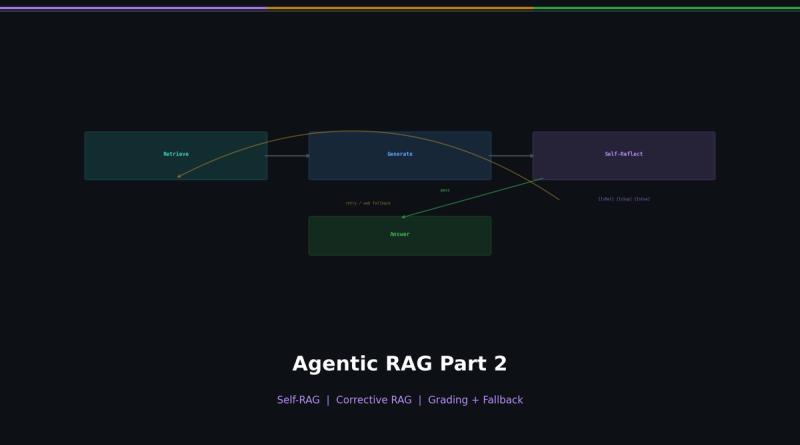
The rest of this series is paid
- ✓ The whole “Agentic RAG” series: 2 posts in English, 2 in Korean
- ✓ 2 Jupyter notebooks
- ✓ One payment, no expiry. Opens when you sign in with the email you pay with.
The series pass needs no account to pay. The subscription needs a free account.