Running autoresearch Hands-On — Overnight Experiments on a Single GPU
From environment setup to agent execution and overnight results analysis. Tuning guide for smaller GPUs and practical tips.
Running autoresearch Hands-On — Overnight Experiments on a Single GPU
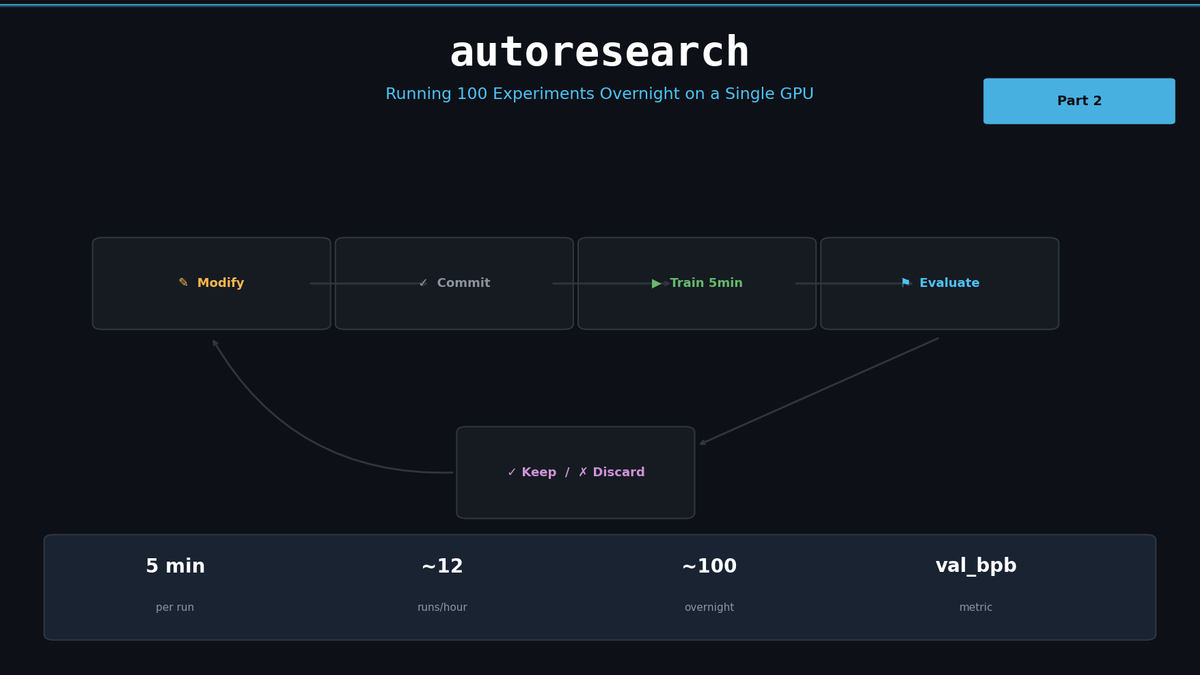
In Part 1, we looked at how Karpathy's autoresearch is structured. Here's the three-line summary:
- A single
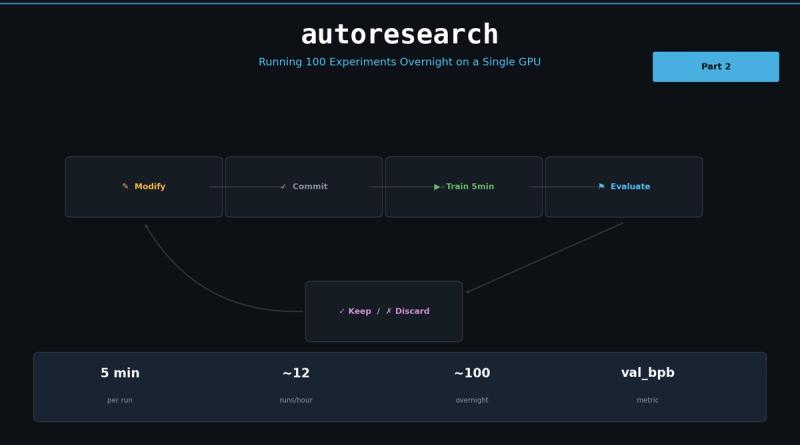
train.pycontains the GPT model + optimizer + training loop. - An AI agent (Claude Code, etc.) modifies this file, trains for 5 minutes, and keeps the change if val_bpb improves — otherwise discards it.
program.mddefines the agent's behavior rules. Humans only edit this markdown file.
In Part 2, we'll set up the environment, launch the agent, and analyze the results from an overnight run.
Environment Setup — Getting Started
Requirements
| Item | Minimum | Recommended |
|---|---|---|
| GPU | NVIDIA GPU (CUDA support) | H100 80GB |
| Python | 3.10+ | 3.12 |
| Package Manager | uv | uv |
| Agent | Claude Code or Codex | Claude Code |
You don't need an H100. It runs on 4090, A100, 3090, and more. The difference is how many tokens get processed within the fixed 5-minute budget. We'll cover GPU-specific tuning later.
The rest of this series is paid
- ✓ The whole “autoresearch hands-on” series: 3 posts in English, 3 in Korean
- ✓ 2 Jupyter notebooks
- ✓ One payment, no expiry. Opens when you sign in with the email you pay with.
The series pass needs no account to pay. The subscription needs a free account.