QLoRA + Custom Dataset — Fine-tune 7B on a Single T4 GPU
Fine-tune a 7B model on a T4 16GB with QLoRA. Dataset construction, training execution, Wandb monitoring, and Before/After comparison.
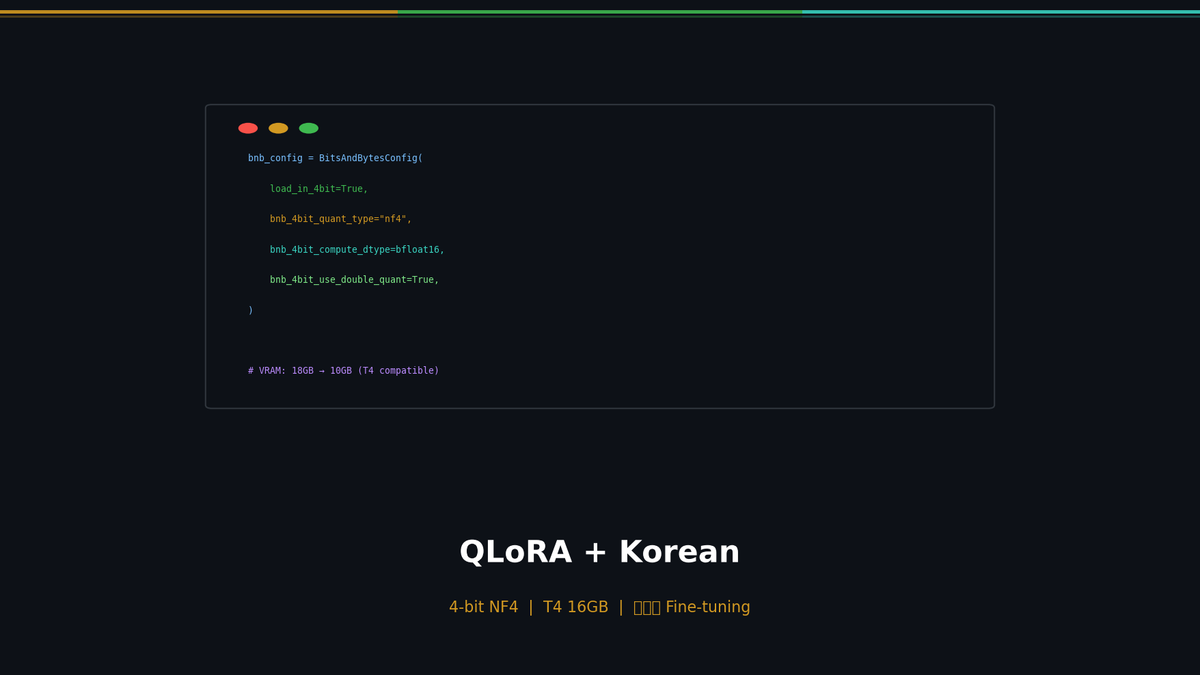
QLoRA + Custom Dataset — Fine-tune 7B on a Single T4 GPU
In Part 1, we covered the theory behind LoRA and fine-tuned Qwen 2.5 7B. That required about 18GB of VRAM on an RTX 3090 (24GB). In this post, we use QLoRA to bring that down to a single T4 with 16GB, and build a Korean-language dataset to meaningfully improve the model's Korean response quality.
Series: Part 1: LoRA Theory | Part 2 (this post) | Part 3: Eval + Deploy
QLoRA: Breaking Through the Memory Barrier
If LoRA reduced trainable parameters by 99.8%, QLoRA goes further and reduces the memory footprint of the model itself.
The rest of this series is paid
- ✓ The whole “LoRA fine-tuning” series: 3 posts in English, 3 in Korean
- ✓ One payment, no expiry. Opens when you sign in with the email you pay with.
The series pass needs no account to pay. The subscription needs a free account.