Local LLM Setup Sheet for 8, 12, 16, 24, and 80 GB GPUs: Models, Quants, Context, and Commands
All measured setups from 8 gpu-fit episodes and 2 serve-ladder posts in one lookup table: Qwen3.5-9B (0.781, +1,612 MiB left in 8 GB), Inkling Q4 8 GB offload (0.917), Inkling Q2 (12 GB, 0.975 at 16K), Inkling Q3 (16 GB, 0.958 at 16K), Inkling Q4 (1.000), Qwen3.5-27B (0.953), and vLLM on 80 GB A100: the solo recipe at 211.0 tok/s for one user, the team recipe at ~1,568 tok/s for 32 users, and 2-card replication at 2,702-2,717 tok/s for 64 users.
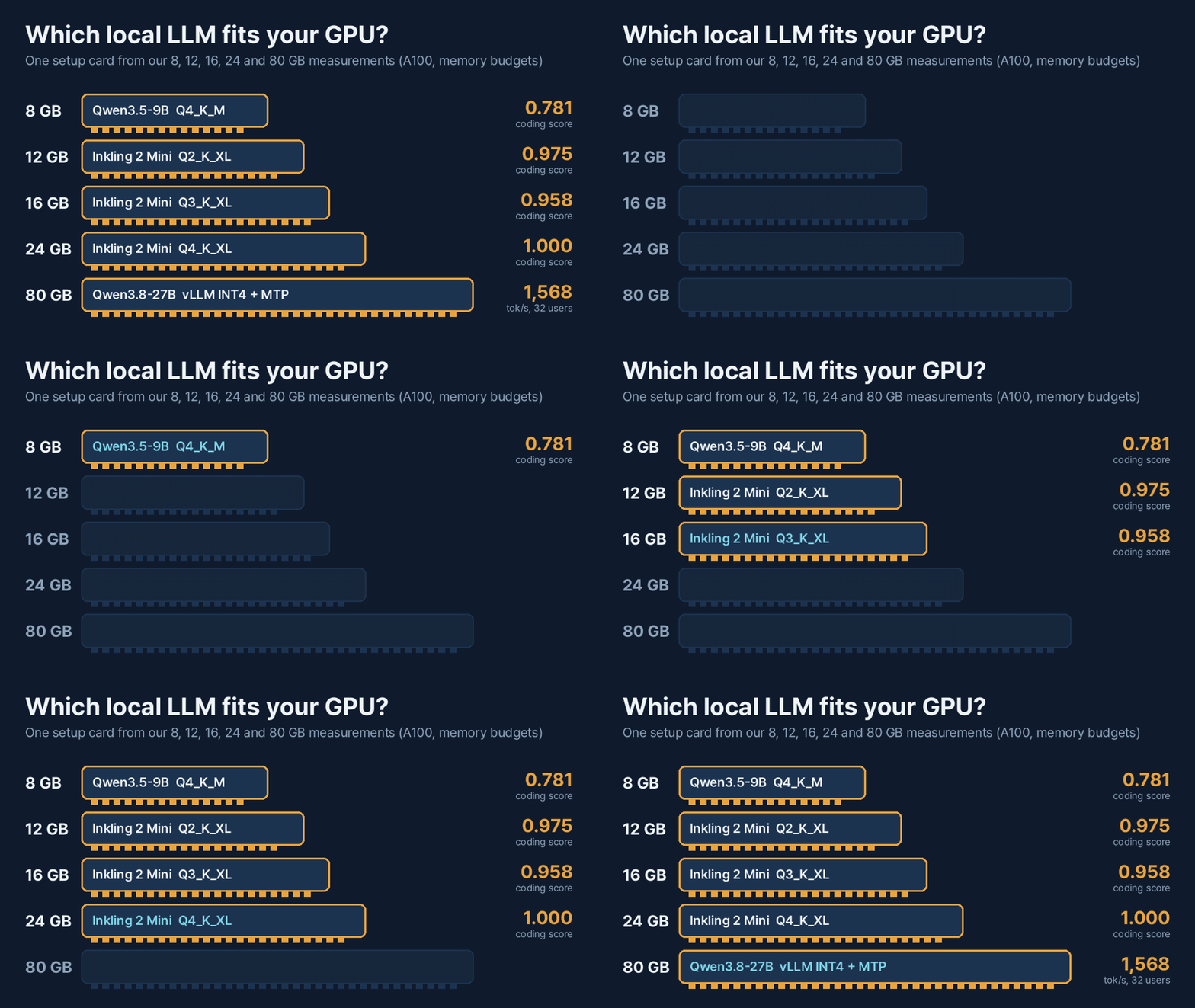
Every local GPU sizing question boils down to one lookup: for a given card, which model, quant, -c, -ub, KV type, or offload flag fits inside memory without losing speed or accuracy?
This gpu-fit series wrap-up brings together our measured numbers across the gpu-fit series (8, 12, 16, and 24 GB budgets) and the serve-ladder series (1-2x 80 GB A100 PCIe) with zero new runs.
The 8, 12, 16, and 24 GB figures were measured on an A100 80 GB PCIe against per-card budgets (GiB x 1,024 - 512 desktop - 16 MiB = 7,664 / 11,760 / 15,856 / 24,048 MiB, with earlier context-budget and multimodal posts using conservative decimal-GB budgets 7,117 / 10,932 MiB, and 14.40 GiB for 16 GB). The 80 GB figures ran directly on 1-2x A100 80 GB PCIe cards without NVLink, and every tok/s figure here is measured on A100 (plus EPYC 7742 64-thread host RAM for the 8 GB MoE offload runs).
1. Single-Card Setups for 8, 12, 16, and 24 GB Budgets
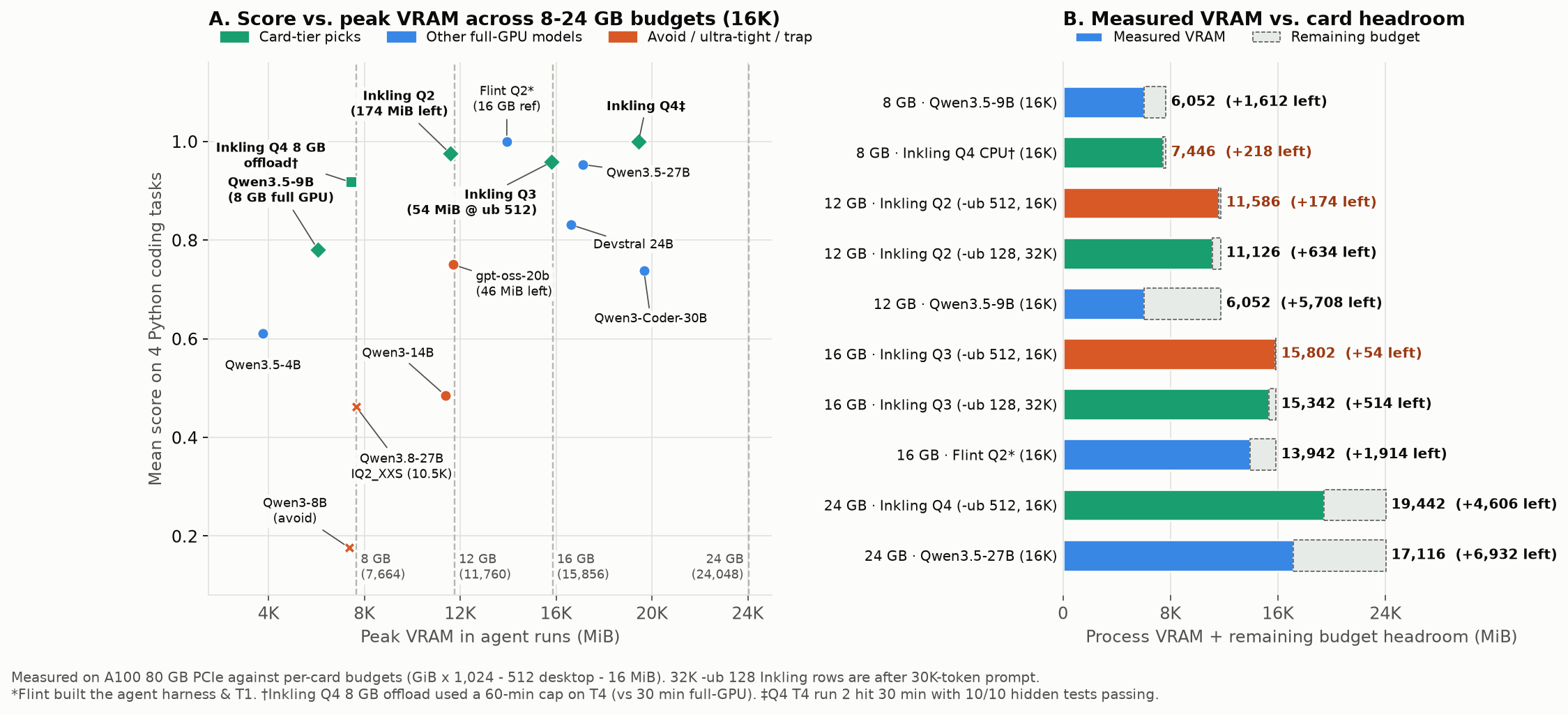
All coding scores below come from the same four hidden-test Python tasks (T1-T4 x 3 runs, 16K context in llama.cpp, 30-minute cap except a 60-minute T4 cap for 8 GB Inkling offload). For Inkling 2 Mini, the extended -c limits (43K, 41K, 121K) indicate the -c at which the server stayed inside budget after processing a 30K-token prompt.
| GPU (Budget) | Use case | Recommended model & quant | Context & key flags | Measured VRAM (Margin) | Score (A100 tok/s) | Source post |
|---|---|---|---|---|---|---|
8 GB (7,664) | Full-GPU coding & general | Qwen3.5-9B Q4_K_M | -c 16384 (at 7,117: f16 32K, q8_0 64K, line fit 50,176) | 6,052 MiB (+1,612) | 0.781 (125) | sotaaz-8gb · ctx-budget |
8 GB (7,664) | Higher-score MoE offload | Inkling 2 Mini UD-Q4_K_XL | -c 16384 -ub 128 --no-op-offload, 16 outer CPU layers | 7,446 MiB (+218) | 0.917 (21.8-23.0 during tasks, 25.17 single bench; 60-min T4) | inkling-8gb |
8 GB (LFM3 7,117 strict, Idol 7,664) | Multimodal · Image-to-3D | LFM3 1.7B/VL/Audio/Omni · Idol bf16 | LFM3 128K-256K / Idol --mode real (raw / alpha-cut) | 3,818-4,924 · 7,380/6,616 (Idol peak +284 vs. 7,664, -263 vs. 7,117) | Verified outputs (unscored) | lfm3-8gb · idol-8gb |
12 GB (11,760) | Top coding score | Inkling 2 Mini UD-Q2_K_XL | 16K -ub 256 or 32K -ub 128 (43K after 30K prompt) | 11,126 MiB (+634, 32K) | 0.975 (42.6; score and speed at 16K -ub 512 with +174 left, -ub 128 measured for memory only) | inkling-2-mini |
12 GB (11,760) | High headroom & long ctx | Qwen3.5-9B Q4_K_M | 16K-128K f16 (q8_0 128K 8.08 GiB, strict 167,936) | 6,052 MiB (+5,708, 16K) | 0.781 (125) | sotaaz-8gb · vram-formula |
16 GB (15,856) | Balanced pick (PPL + 32K+) | Inkling 2 Mini UD-Q3_K_XL | -c 32768 -ub 128 (41K after 30K prompt; Q2 for 80K-115K) | 15,342 MiB (+514, 32K) | 0.958 (42.0, 16K -ub 512; PPL 6.08) | inkling-2-mini |
16 GB (15,856) | Reference row (bias caveat) | Flint UD-Q2_K_XL | -c 16384 f16 | 13,942 MiB (+1,914) | 1.000 (108) | sotaaz-8gb |
16 GB (15,856) | Full 256K context | Qwen3.5-9B Q4_K_M | -c 262144 f16 (model training ceiling) | 13,947 MiB (13.62 GiB, +1,909; also under decimal 14.40 GiB) | Not scored at 256K | ctx-budget |
24 GB (24,048) | Top score (tied with Flint) + vision (mmproj) | Inkling 2 Mini UD-Q4_K_XL | Default -ub 512 51K / -ub 128 121K (+710 MiB mmproj) | 19,442 MiB (+4,606, 16K) | 1.000 (41.3, PPL 6.04) | inkling-2-mini |
24 GB (24,048) | Standard dense alternative | Qwen3.5-27B Q4_K_M | -c 16384 f16 (no ranking vs. Flint: p = 0.10 is the smallest value a 3-run permutation test can give) | 17,116 MiB (+6,932) | 0.953 (47) | sotaaz-8gb |
Flint UD-Q2_K_XL is the model we used to build our agent harness and task T1, so it does not run under the same conditions as the others; we keep it as a reference row only.
Read every top pick alongside two operational checks:
- Headroom separates safe daily setups from cliff-edge runs. On 12 GB at 16K
-ub 512, InklingQ2scored0.975but left only174 MiB(11,586vs.11,760), compared withQwen3.5-9B's5,708 MiBmargin. On desktop cards where display allocation exceeds512 MiB, drop Inkling to-ub 256at 16K or-ub 128at 32K (+634 MiBleft), and on 16 GB useInkling Q3with-ub 128(+514 MiBat 32K after a 30K prompt) rather than default-ub 512(54 MiBleft at 16K). On 12 GB,gpt-oss-20b(0.750) likewise left just46 MiB. - Setups to avoid: On 8 GB,
Qwen3-8B Q4_K_Mscored0.176(barely above the0.115no-edit floor, failing 128 of 179 file edits) and already uses9,668 MiBat 32K because all 36 layers allocate KV cache. Squeezing a huge model via ultra-low bits backfired too:Qwen3.8-27B UD-IQ2_XXS(-c 10752 -ub 128 -ctk q4_0 -ctv q4_0,7,654 MiBpeak) scored0.462overall and0/10on Task 4 in all nine runs across its three settings (big-on-8gb analysis).
2. 80 GB A100 (1-Card and 2-Card) Serving Benchmarks
For a single user, llama.cpp and vLLM decode at almost the same pace (~86 tok/s each on Qwen3-8B bf16), whereas at 64 overlapping requests vLLM delivered roughly twice the throughput of uncached llama.cpp (vLLM vs. llama.cpp).
Across 1-2x A100 80 GB PCIe cards (no NVLink) serving Qwen3.8-27B over 96 prompts (up to 1,024 tokens, temperature 0), our serve-ladder runs establish the deployment choices below:
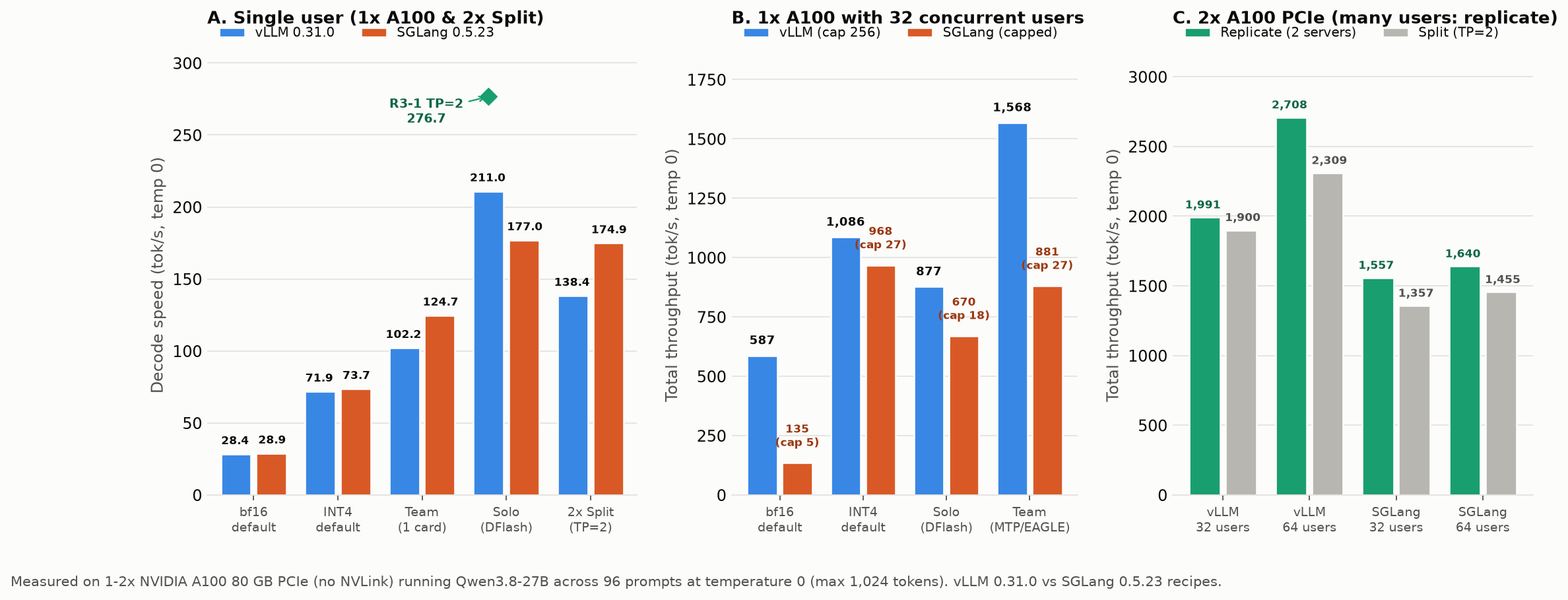
| Setup | Engine & recipe | 1 user (tok/s) | 32 users (tok/s, TTFT p95) | 64 users (tok/s, p95) | Selection rule |
|---|---|---|---|---|---|
| 1x 80 GB baseline | vLLM bf16 (R1) / INT4 (R2) | 28.4 / 71.9 | 587 (0.92 s) / 1,086 (1.06 s) | - | Switching bf16 -> INT4 alone yields 2.5x (1 user) and 1.8x (32 users) |
| 1x 80 GB solo | vLLM R3-1 (DFlash2, 7 draft tok) | 211.0 (t=0.7 186.8) | 877 (1.16 s) | - | Fastest single-card solo config; slower than plain INT4 at 32 users |
| 1x 80 GB shared | vLLM R3-32 (MTP, 1 draft tok) | 102.2 | ~1,568 (0.87-0.89 s) | 1,856 (1.60 s) | Default choice for one shared card (serve-ladder Part 1) |
| 1x 80 GB SGLang | SGLang S3-1 / S3-32 | 177.0 / 124.7 | 670 (27.2 s) / 881 (14.4 s) | 883 (44.8 s) | S3-32 capped at 27 concurrent requests, queuing 5 of 32 users; S3-1 capped at 18 (Part 2) |
| 2x 80 GB PCIe copy | vLLM D1 (1 server per GPU) | 102.9 | 1,981-2,002 (0.50-0.54 s) | 2,702-2,717 (0.87-0.88 s) | Winner for team concurrency (SGLang SD1 64u 1,631-1,652) |
| 2x 80 GB PCIe split | vLLM D2 (TP=2) | 138.4 (R3-1 TP=2 276.7, 1 run) | 1,900-1,901 (0.63 s) | 2,297-2,320 (1.19-1.20 s) | For one user: split plus the solo recipe (SD2 174.9) |
| 2x 80 GB PCIe per role | vLLM D3 (GPU 0 R3-1, GPU 1 R3-32) | GPU 0 211.0-211.1 | GPU 1 1,570-1,574 | - | When you need both solo and team serving; neither slowed the other |
3. Four-Step Procedure to Size Any New Model or Card (6, 32, or 48 GB)
If your card sits outside the table (such as 6, 32, or 48 GB) or a new release drops tomorrow, apply the exact sequence below instead of a layer-counting VRAM formula — standard estimators overshot actual memory by 14,009 MiB on Gemma 3 4B and 12,097 MiB on Qwen3.5-9B at 128K (Part 1), while counting physical layers on Inkling 2 Mini under-predicted KV cache by half (24 vs. 48 loop visits).
- Read real free VRAM first and pick a KV-friendly architecture. Run
nvidia-smi --query-gpu=memory.total --format=csvand subtract the512 MiBdesktop reserve to get your budget (the16 MiBmargin is subtracted only in the step 2 formula), and favor hybrid/sliding-window models when context matters (Qwen3.5-9Bgrows33 MiB/1Kvs.145 MiB/1KforQwen3-8B). ForInkling 2 Mini, ensurellama.cpp b12611+(PR #32704) and use either root files downloaded after Nov 23 14:54 UTC orMainline_Support/(rename.gguf_fileto.gguf) (b12603hits PPL117.34; the old root layout throwsblk.24). - Fit
-cwith two short launches, then confirm once. Launch at-c 4096(M1) and-c 8192(M2), computemax -c = 4,096 + (budget − 16 − M1) ÷ ((M2 − M1) ÷ 4,096), round down to a multiple of1,024, clamp ton_ctx_train, and run one confirmation check with a real prompt. Attach--mmprojfrom the first launch when sizing multimodal models (Inklingadds+710 MiB;LFM3adds+568-1,320 MiB). - Open memory via
-ctk/-ctvand-ubin that order. Keepf16KV whenever it fits. When short on context, switch to-ctk q8_0 -ctv q8_0(Qwen3.5-9Bon 8 GB doubles from32Kto64K, whileQwen3-8Bat 64K decodes at56%off16speed). Reserveq4_0for cases where ~1 GiB decides fit (PPL about 1% worse), and avoidbf16,q5_1, mixed K/V, oriq4_nl(KV cache guide). On relative-bias models likeInkling 2 Mini, lowering-ubfrom512to256or128cuts CUDA compute buffers nearly in half twice for a4-16%A100 prompt-speed trade-off; going from512to128raised max-cabout 2.4x (18Kto43Kfor 12 GB Q2). - Offload only MoE layers outer-first with
--no-op-offload, then test on your real workflow. Avoid spilling dense layers to host RAM (Qwen3.8-27B -ngl 57dropped decode from49.8to1.7 tok/son 8 EPYC threads). On looped MoE weights likeInkling 2 Miniin 8 GB,--no-op-offloadprevents default op offload from pulling4,082-6,705 MiBback onto the GPU, and outer-first-otran1.11-1.33xfaster than front-first--n-cpu-moe. And onQwen3.5-9Bagents, a simple"keep going"nudge beat same-model self-review (+0.075vs.+0.042, at under half the wall time) (self-review test).
4. Copy-Paste Launch Commands by GPU Tier
8 GB (`Qwen3.5-9B` Full-GPU / `Inkling Q4` Outer-16 Offload)
# 1) 8 GB full GPU (32K f16, scored at 16K; add -ctk q8_0 -ctv q8_0 -c 65536 for 64K)
hf download unsloth/Qwen3.5-9B-GGUF Qwen3.5-9B-Q4_K_M.gguf --revision 3885219 --local-dir models
llama-server -m models/Qwen3.5-9B-Q4_K_M.gguf \
  -c 32768 -ngl 99 -fa on --parallel 1 --jinja --port 8080

# 2) 8 GB higher-score MoE offload (requires llama.cpp b12611+)
hf download unsloth/Inkling-2-Mini-GGUF Inkling-2-Mini-UD-Q4_K_XL.gguf --local-dir models
llama-server -m models/Inkling-2-Mini-UD-Q4_K_XL.gguf \
  -c 16384 -ub 128 -ngl 99 -fa on --parallel 1 --jinja --no-webui \
  --no-op-offload \
  -ot 'blk\.(0|1|2|3|4|5|23|22|21|20|19|18|6|7|8|9)\.ffn_(gate_up|down)_exps\.=CPU' \
  --port 8080
12, 16, and 24 GB (`Inkling 2 Mini` + `Qwen3.5-27B`)
# 12 GB (-ub 128 for 32K; use -c 16384 -ub 256 if 16K is enough)
hf download unsloth/Inkling-2-Mini-GGUF Inkling-2-Mini-UD-Q2_K_XL.gguf --local-dir models
llama-server -m models/Inkling-2-Mini-UD-Q2_K_XL.gguf \
  -c 32768 -ub 128 -ngl 99 -fa on --parallel 1 --jinja --no-webui --port 8080

# 16 GB (Q3 at 32K)
hf download unsloth/Inkling-2-Mini-GGUF Inkling-2-Mini-UD-Q3_K_XL.gguf --local-dir models
llama-server -m models/Inkling-2-Mini-UD-Q3_K_XL.gguf \
  -c 32768 -ub 128 -ngl 99 -fa on --parallel 1 --jinja --no-webui --port 8080

# 24 GB (Q4 at 32K, scored at 16K; adding --mmproj models/mmproj-F16.gguf loads around 22,152 MiB before images)
hf download unsloth/Inkling-2-Mini-GGUF Inkling-2-Mini-UD-Q4_K_XL.gguf mmproj-F16.gguf --local-dir models
llama-server -m models/Inkling-2-Mini-UD-Q4_K_XL.gguf \
  -c 32768 -ngl 99 -fa on --parallel 1 --jinja --no-webui --port 8080

# 24 GB standard dense alternative (Qwen3.5-27B Q4_K_M at 16K)
hf download unsloth/Qwen3.5-27B-GGUF Qwen3.5-27B-Q4_K_M.gguf --revision 3221f17 --local-dir models
llama-server -m models/Qwen3.5-27B-Q4_K_M.gguf \
  -c 16384 -ngl 99 -fa on --parallel 1 --jinja --port 8080
On /v1/chat/completions, Inkling 2 Mini emits its reasoning trace in the reasoning_content field before the final reply. Full 80 GB vLLM commands (R3-1, R3-32, and 2-card D1/D2) are copied ready-to-run in serve-ladder Part 1.
Three checks before locking your card setup
- Measure
memory.freeon your actual card first. Desktop and browser GPU allocations easily exceed512 MiB, which turns174 MiB(12 GB Inkling Q2 -ub 512) or54 MiB(16 GB Inkling Q3 -ub 512) margins into OOMs. On those cells, step down to-ub 256/128or lower-cby one1,024-token step. - Check the startup log for silent
n_ctxclamps and concurrency caps.llama-serversilently shrinks-cton_ctx_trainwhen overspecified, andSGLangcappedmax_running_requestsat27on our 80 GB A100 without throwing an error. - Run one real prompt and check
git diffafter agent runs. Real prompts added12-108 MiBabove load idle across our runs, and smaller models occasionally report success after visible tests pass without editing files (git diffcatches zero-edit stops immediately).
Subscribe below as we add measured rows for new local models and GPUs.